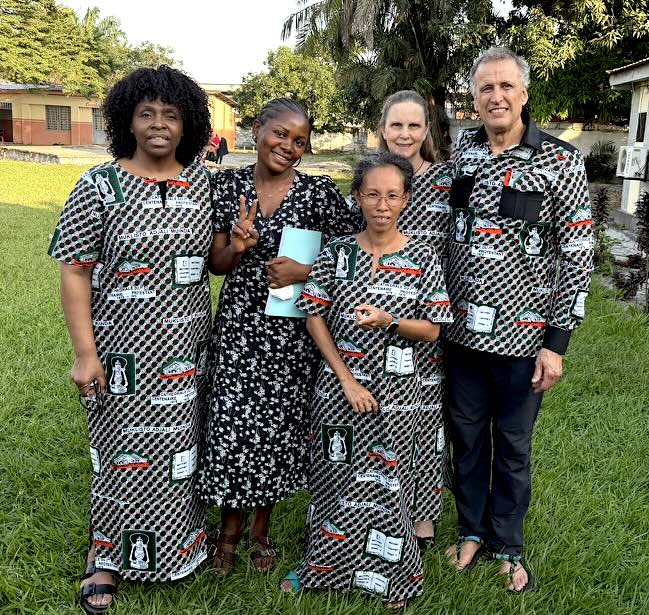
In the midst of daily bombardments in the Middle East and devastating news reports, we’re finding reasons to hope in some hard places in Africa. Gracie and I just completed the first of two five-day trainings here in Kinshasa, DRC (Democratic Republic of Congo). We felt called here for many years– but the connections were never quite right until now.
Our first impressions were that things are quite grim and dire. Right away we were struck by the heat– 92 degrees F (33 C)- with 80% humidity– and then there’s the air pollution from so many vehicles ground to a near halt plus heaps of burning plastics and toxic garbage.
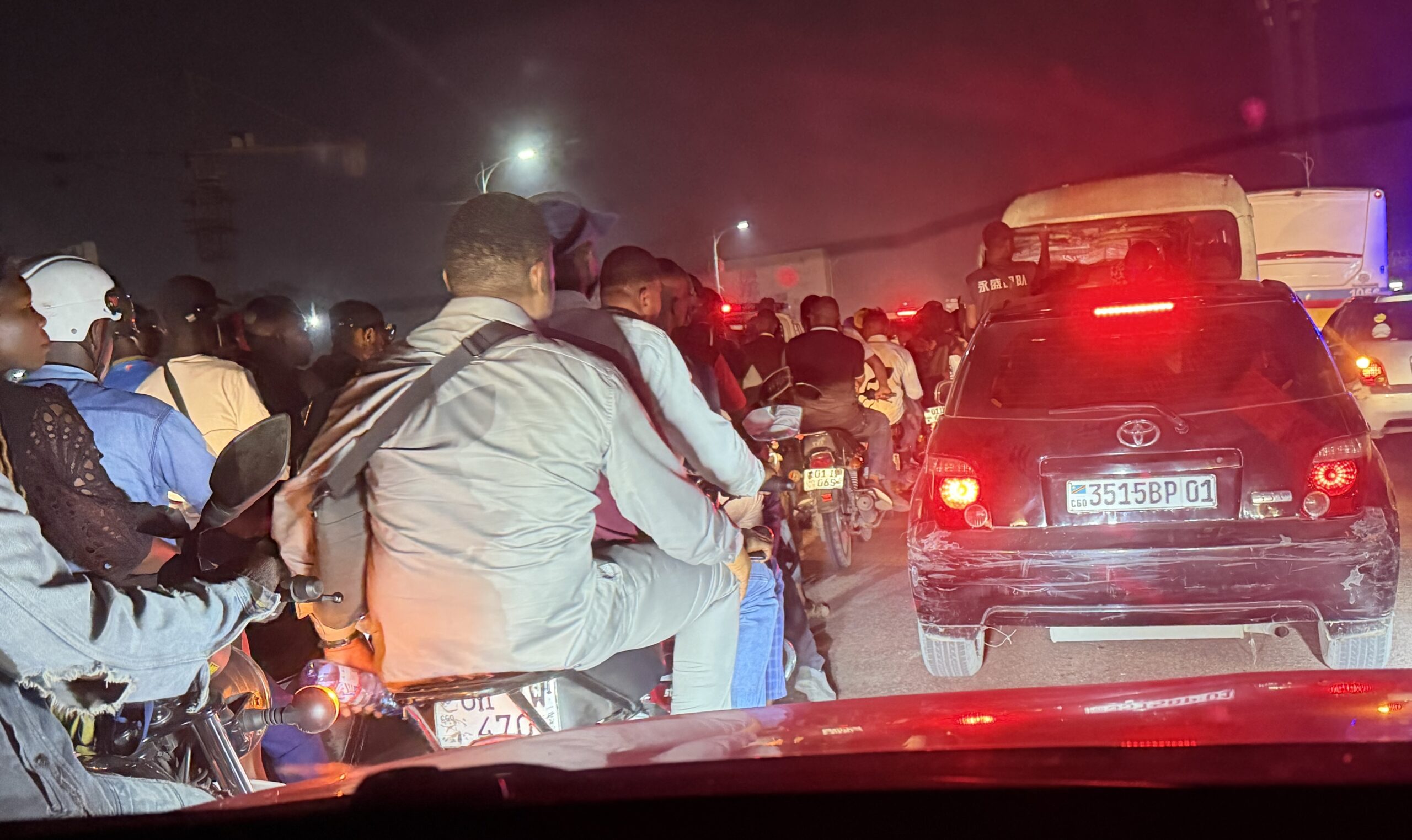
Right away, we experienced the famous “embouteillages” (traffic jams)– which are like nothing we’ve seen anywhere. It makes Seattle bumper-to-bumper rush hour look like paradise (well not quite).
Here there are masses of people, walking, carrying loads, on motorcycles piled with people squeezing between big trucks and every manner of dented and battered vehicle. You’d never see even one car in the US or Western Europe like most every car or truck in the DRC. There are 18.5 million people living in Kinshasa– and the DRC has a total of around 200 million.
The infrastructure is so messed up– due in part to the fact that there is a war going on in the eastern Congo. It took us over three hours to travel from the airport to the site of our training– which with normal traffic would only take 20 minutes.
We learned from our hosts that a bus driver’s strike was scheduled to begin the first day of our training, which meant than instead of the 150-200 who’d signed up, only 60 were able to attend the entire five days. Most of those 60 people walked (some of them for two to three hours) to the Course—in the sweltering heat.
The particants traveled in the sweltering heat by foot (some of them for two to three hours), on the back of motorcycle taxis, or in three-wheeled vehicles called bajajis or tuk-tuks. They came eager to learn, expressing their enthusiasm through lots of comments and questions and vibrant acapella worship (see video below).
Our teaching was done in French, by our team including Gracie and I, Vera, who grew up in France, but whose family is from Cameroon and Nigeria, and Viviane, who is from Mauritius.
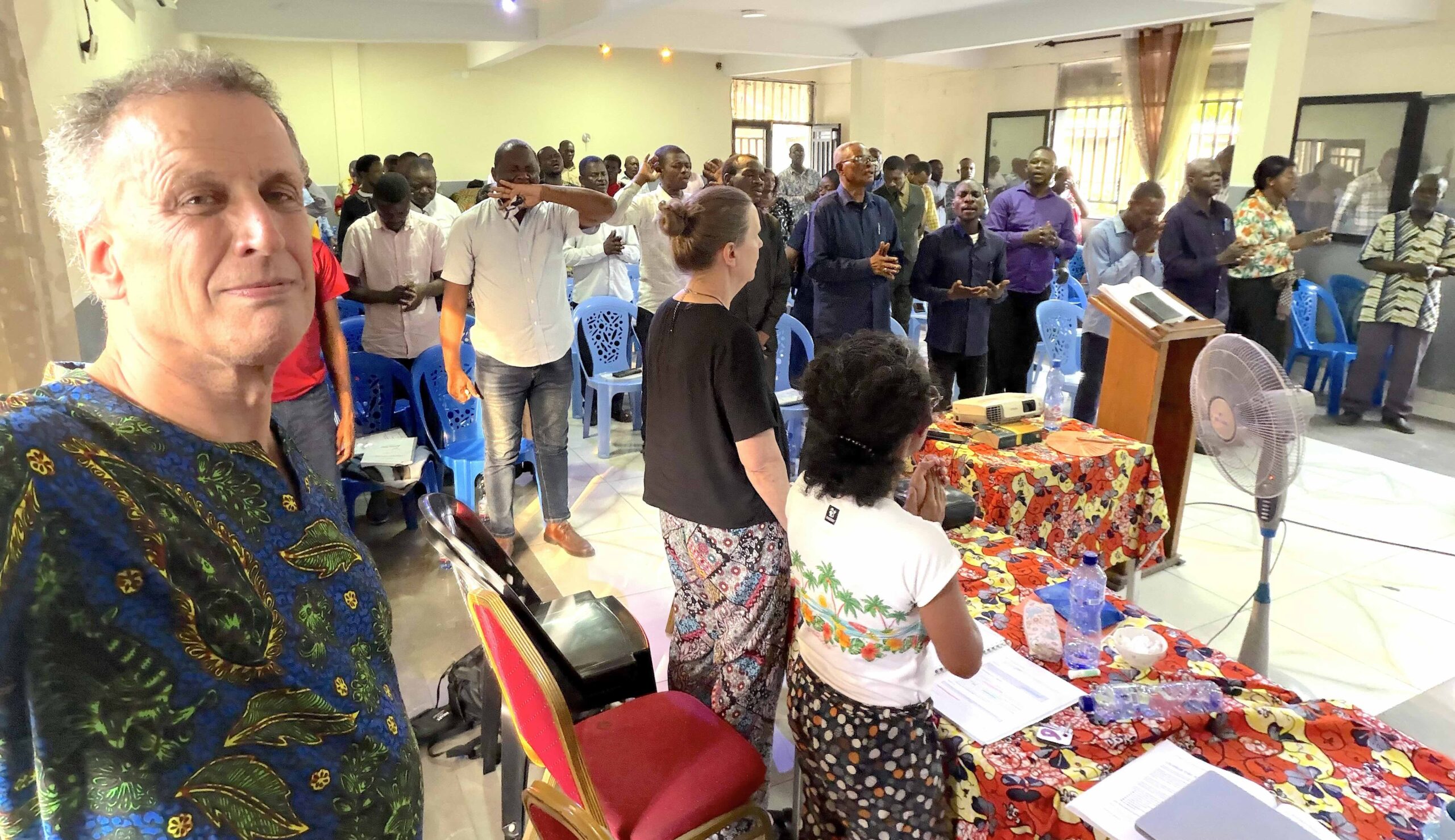
Contextual Bible study is core to our trainings. In settings where people are used to listening to preachers and teachers but are rarely invited to share their own ideas or questions, we seek to model a way of teaching that engages people’s participation and empowers them to discover for themselves the liberating messages in Scripture. Bibliodramas are especially effective at helping people see and experience the meaning of Biblical texts.
In the story of Jesus crossing to the other side of the Sea of Galilee with his disciples (Mark 4:35-41), we discover a shocking contrast between disciples and the demoniac whom they encounter on “the other side.”
I invite twelve people to come forward to represent Jesus’ disciples- and ask for a volunteer to play Jesus and another the Gerasene demoniac. I have the twelve disciples form two lines of six, and to face each other, then ask people to imagine they are the boat and the floor at the front is the sea. I place a chair between the two lines of six people and ask the man playing Jesus to take a seat in the boat.
We read the text about how as they cross the sea, a storm arises, and strong wind and waves threaten to capsize the boat—while Jesus remains fast asleep. Gracie waves a big scarf over the boat and makes sounds of wind. As we read on, I ask one of the disciples to speak out: “Master, don’t you care that we are perishing?” As we read on, the guy playing Jesus stands and asks:
“Why are you afraid? Do you still have no faith?”
“Why am I?” I ask myself.
He then rebukes the wind and the waves, modeling a kind of authority that is foreign to us—and Gracie stops waving the scarf and making wind sounds. As we read on, the people playing the disciples look astonished and one of them reads:
“Who is this, that even the wind and waves obey him?”
I ask the audience how the disciples see Jesus. What image do they have of him? We notice together that they call him “teacher,” and they are not sure if he cares whether they drown. Once he calms the storm they still don’t know who he is, asking “who is this?”
“Would pastors here in Congo baptize people like Jesus’ unbelieving disciples?” I ask.
“Would you baptize people who only saw Jesus as a teacher, and didn’t know who he is (God’s Son, the Christ, God in human flesh)?”
Some of the people looked shocked and others laughed and shook their heads– realizing Jesus has chosen people who are full of fear when adversity comes. He even describes them as having “no faith.”
I’d asked Viviane, one of our teachers from Mauritius to play the tormented demoniac living in the tombs. She was sitting in the corner to the right, and was now ready to spring into action. I had a volunteer read Mark 5:1 and invited the disciples and Jesus to move across the sea towards the “shore” on the right side of the room. Once they land, Viviane jumps out of her chair and runs towards Jesus, bowing before him and crying out:
“What business do we have with each other, Jesus, Son of the Most High God? I implore you by God, do not torment me!”
We look together at how this man who’d been living in the tombs, who no one could restrain, who was self-harming and crying out night and day, knew Jesus’ identity and showed his allegiance far more than the disciples—but he still needed liberation.
After I taught about how the people were colonized by the Roman Empire, and how the demons are named “Legion” (referring to a Roman military unit), I asked whether there are people in the DRC who were oppressed by evil spirits associated with colonization. Seeing past Belgian colonizers and current mineral extraction by modern-day equivalents to Legion seemed to visibly bolster people’s confidence in the relevance of Scripture for now.
The man tells Jesus to stop tormenting him because Jesus was telling the evil spirits to leave him. We realized together how painful it is for people to be freed from the deep spiritual oppression from colonialism- contributing to self-hatred, violence, passivity, poverty, dependency.
That Jesus casts the colonizing spirits into pigs shows he’s willing to commit an act of sabotage against a parasitic war economy to save even one man, inviting further reflection on what that means for us now.
We were deeply encouraged by people’s heartfelt appreciation for our teaching and are receiving more and more invites. We are currently in Lesotho, and preparing to send two teams to teach all next week in Solwezi, Zambia and in Malawi and Mozambique in April.
We’ve been preparing to offer more trainings in Francophone Africa,where grass-roots church leaders often lack theological/ministry formation. We now have six French-speaking teachers involved and have already completed trainings in Paris, Switzerland, Morocco, Burundi and Benin with hopes of training more trainers so can we expand our reach.
I shared with one of our hosts, Lucien, the director of the Campus Pour Christ in DRC, a dream I had about six years back. In the dream, an African man came to me and said: “Venez à Gabon!” (Come to Gabon). I told him I was sad to say that I’d never responded to this dream. He told me that maybe I never asked God “when?”
“I have a close colleague who leads a ministry in Gabon who I’m sure would want to host this training,” he said. “I will connect you!”
Over the next few days Lucien connected me with ministry leaders who want to host our Certificate in Holistic Liberation in Gabon, Chad and Cameroon.
Meanwhile our previous hosts in Burundi have invited us to offer our training in anew area of Burundi, and to include a “trainer of trainers” course to equip more teachers. We are also scheduled to offer back-to-back modules in Benin the last two weeks of July.
We are in serious need of around $30,000 to offer nine five-day trainings to over 1500 participants. We welcome contributions towards course expenses online here, or through sending a check to Tierra Nueva (Attn: The People’s Seminary), PO Box 410, Burlington, WA 98233, USA.
UK donations can be given through our account at Stewardship. Click here to set up your sign-in details.
Please hold us and our African trainers and the course participants in your prayers this next week as we complete our final course in Lesotho, as people travel long distances daily and teach in Solwezi, Zambia. Check out the video below to experience the joy of worship in the DRC.