|
Responding to the blaspheming of Jesus’ name — Bob Ekblad
I’m deeply troubled by the extreme harm done to the name of Jesus, and to the faithful witness of Jesus’ followers over centuries and especially now. When those claiming to be Christian endorse or justify unjust leaders, governments and laws, or are silent in the face of violence, lies and corruption, many are rightly outraged– and the Apostle Paul’s words are tragically confirmed:
“For the name of God is blasphemed among the nations because of you,” just as it is written” (Rm 2:24).
Paul writes this in response to the offensive actions of fellow Jews, who were claiming faithfulness to God while transgressing core teachings of Scripture. This verse comes at the end of prophetic exposé of the spiral of evil that results from “suppressing the truth in unrighteousness” (Rm 1:18-32).
As the world looks on at Israel’s injustices and extreme retributive violence against people living in Gaza and the West Bank it makes the God they claim to worship look cruel or impotent. The image of God reflected by Israel’s killing of 75,000 Palestinians (many of whom were women and children) in response to Hamas’ killing of 1,200 Israelis and the taking of hostages couldn’t be farther from the God of grace and love who promised to bless all the families of the earth through Abraham’s descendants (Gn 12:3).
But God’s name being blasphemed “because of you” equally applies to Christians, the non-Jewish beneficiaries of God’s blessing through Abraham’s descendant— God’s people through conversion!
Blaspheme (blasphemeo in Greek) is defined as speaking in such a way as to harm or injure reputation, and is synonymous with revile, defame or malign.
I have witnessed Jesus’ name and the Christian faith maligned, defamed, blasphemed as a direct result of North American Christians supporting oppressive leaders and policies. For 46 years we lived and ministered amongst poor and marginalized people in countries and communities directly harmed by US policy.
We have seen harm done to people on the margins in the USA due to our sorely inadequate response to mental health disorders, addiction and homelessness and our harsh penal system. Conservative Christians have voted in politicians committed to cutting funding to programs that help the poorest and most marginalized people, and punishing more severely those who need special treatment.
As White Americans who identify as Jesus followers ministering most of our lives among people who fit in the category of BIPOC (Black, Indigenous, and People of Color), we have had to differentiate Jesus and ourselves from the negative counter-witness of Christians caught up in partisan politics, racial and national identity and defending their own rights.
We witnessed firsthand the evils of US support of oppressive governments while living in Honduras through the 1980s. It was painful for us to see many American Christians supporting the Reagan and Bush Administrations, who were directly linked to death squads and oppressive militaries that terrorized and killed or disappeared hundreds of thousands in Central America (Approx. 200,000 in Guatemala, 80,000 in El Salvador, 44,000 in Nicaragua, hundreds in Honduras).
Public Christian agreement with US wars in Iraq, Afghanistan, and more recent support of Israel’s war in Gaza and the harsh treatment of immigrants have compelled us to clarify continually that Jesus’ way has nothing to do with oppression, violence, deportation, war and any kind of injustice.
This has often put us at odds with fellow Christians, who at best may be acting in ignorance. Now, with so many Christians either overtly supporting the Trump Administration and Maga agenda, or remaining silent, the name of Jesus, and Christian witness is being trashed, maligned, blasphemed against more than I’ve seen in my lifetime. This grieves me deeply.
God’s people in exile now
Now when Paul is referring to God’s name being blasphemed, he’s citing the prophet Isaiah’s words, which provide background that is highly relevant to what’s happening today.
Isaiah addresses the people of God living in exile under Babylonian captivity. Throughout Isaiah 1-39 the prophet warns God’s people still in the land that they will be weakened by allegiance to false gods– to the point that they are vulnerable to being carried off into exile, where they’d be subjugated— which is exactly what happened.
“Those who rule over them howl, and my name is continually blasphemed all day long,” the Lord laments through the prophet Isaiah (Is 52:5).
Today, idolatry among those who claim to follow Jesus has resulted in them/us being carried off into exile by the powers. Idolatry, (which looks like allegiance, over-valuing, undue loyalty, and even worship) is widespread in America now, including amongst Christians. It is visible in the overvaluing of money, self, nation, laws, party, flag, race, news media, politicians, democracy, and even values like religious freedom. People are captured by these false gods, carried away into a kind of servitude that we often fail to recognize.
Many people feed almost continuously on news media that supports their biases. Sounds like idolatry to me! The amount of attention and the faith put into television personalities and social influencers is astounding. I witnessed this up close as my own parents watched Fox News and other right-wing influencers almost continuously in the later years, making any kind of effective change in their thinking through conversation almost impossible.
When we have little to no direct proximity to people suffering injustices (immigrants, the homeless, incarcerated, the addicted and the poor), it is much harder to discern the veracity of news reports about these people.
Out of ignorance many people approve of horrific injustices, and blind allegiance to their authority sources. This is deeply offensive to victims, their advocates and to God.
How can anyone claiming to follow Jesus possibly support the harsh treatment of immigrants and their advocates in the Immigration and Custom Enforcement (ICE) actions across the United States? How can anyone calling themself a Christian identify with leaders who are so obviously filled with pride, denying truth, falsely accusing their adversaries, elevating violence, threatening destruction, and profiting through shameless corruption?
When we are captive to highly-crafted propaganda, and feed on outright lies presented brilliantly as the truth, we become increasingly closed to viewpoints or news that challenge our assumptions. If our viewpoints are seriously challenged, we may not want to risk breaking with our social network for fear of losing friends. If we are church or ministry leaders, we may be tempted to remain silent to avoid losing church members or donors. We choose slavery over freedom, allowing ourselves to be carried into exile which is called freedom. But this is nothing new.
In the name of Jesus, the Crusaders killed, European colonizers seized land and subjugated peoples, slave-traders and slave-holders enslaved Africans, and settlers killed and took land from Native peoples.
When people who call themselves Christians side with the rich and powerful, justifying violence and injustice– great harm is done. The idolatry of nation, money, whiteness, political and military power, and other powers by Christians cause people who are hurt by these forces to blaspheme the name of Jesus.
As we teach and minister around the world, we meet fellow Christians in country after country, carrying the burden of having to respond to a widespread rejection of Jesus. Many people reject Christianity as “the White man’s religion,” having been harmed by grave injustices and harsh attitudes perpetuated by leaders and policies that Christians have supported. It is time for people of faith to publicly disassociate from unjust leaders, and pledge total allegiance to Jesus and his Kingdom.
The prophet Ezekiel describes God’s extreme displeasure at idolatry and its effects with direct, hard-hitting words.
“Therefore I poured out my wrath on them for the blood which they had shed on the land, because they had defiled it with their idols” (Ez 36:18).
This prophetic critique serves as a strong warning of coming judgment, where people become aware of their wrongdoing, setting the context for a new way forward.
Isaiah lifts up the role of the peacemaker and proclaimer of good news among those carried off into exile.
“How lovely on the mountains are the feet of the one who brings good news, who announces peace and brings good news of happiness, who announces salvation, and says to Zion, “Your God reigns!” (Is 52:7).
No president, no country, no currency, no market, no billionaire reigns! The One and only God reigns. This higher, invisible reality must be announced. And we must invite people to confess and renounce idolatry and leave our places of exile—our bondage to the powers. Isaiah writes:
“The Lord has bared his holy arm in the sight of all the nations, that all the ends of the earth may see the salvation of our God,” a text that is fulfilled in Jesus as he is lifted up on the cross (Jn 12:32).
A call for a new exodus
“Depart, depart, go out from there, touch nothing unclean; Go out of the midst of her, purify yourselves,” cries Isaiah (Is 52:11).
Isaiah here uses language from the Exodus, where God’s people literally left the land of slavery. While physically leaving your country, church or social network may be necessary, this call most certainly refers to spiritual and emotional separation– and whatever purifying yourself means.
The prophet Ezekiel develops the call to purification further and deeper in Ezekiel 36. Ezekiel speaks of idolatry as defilement, using the language of clean-unclean. Citing the Lord, Ezekiel writes:
“When they came to the nations where they went, they profaned my holy name, because it was said of them, ‘These are the people of the Lord; yet they have come out of his land’” (Ez 36:20).
Exile is place to which you’ve been carried away by powers you’ve served, which have enslaved you– perhaps unknowingly. Finding yourself “outside the land” is coming to recognize your alienation, your estrangement– the “land” symbolizing the place where God has called you. Conversion involves leaving your enslavement to the powers– and returning to God and to your highest calling.
Ezekiel describes how God will vindicate himself as we receive his purifying presence—offering hope in these times of accelerating darkness and chaos.
“Then I will sprinkle clean water on you, and you will be clean; I will cleanse you from all your filthiness and from all your idols. “Moreover, I will give you a new heart and put a new spirit within you; and I will remove the heart of stone from your flesh and give you a heart of flesh. “I will put my Spirit within you and cause you to walk in my statutes, and you will be careful to observe my ordinances” (Ez 36:25-27).
May we leave behind the false ways and become more serious seekers of the truth– informing ourselves through serious journalism and study. May we seek authentic relationship with those whom society demonizes or scapegoats, the stigmatized and rejected. May we consider afresh Jesus, who identified as God’s own Son, but was rejected by his own people and executed by the Roman Empire. May we choose to follow him more diligently, paying close attention to his teaching and practice so it will inform our own. May we seek to maintain communication with Christians we disagree with– challenging them, and allowing ourselves to be challenged.
I’m asking myself how I can leave my place of exile– whatever keeps me in the dark or enslaved in any way. I’m trying to follow Jesus out of America and into the Kingdom of God—the only place of true freedom. May the Holy Spirit give you eyes to see what that looks like for you, and the faith and courage to act accordingly.
Responding to US actions against Venezuela (and Greenland)

The following is a talk I gave Saturday, January 17, 2026 at a protest rally “Hands off Venezuela” in Bellingham, Washington.
My name is Bob Ekblad. I’m a theologian and pastor, co-founder and director of Tierra Nueva—a ministry based in the Skagit Valley. We started in 1994 as a ministry serving farmworkers and jail inmates after living amongst the poor in Central America throughout the 1980s. We are committed to accompanying people affected by immigration, addiction and incarceration. My wife and I and colleagues pastor a faith community in Burlington, and offer trainings around the world through The People’s Seminary– equipping people to serve society’s most vulnerable.
I want to remind us now that we gather this afternoon on the ancestral homeland of the Coastal Salish peoples. In the 1830s European settlers started arriving here– many of whom were direct descendants of English colonizers (like my mother’s relatives, whose ancestry goer back to the original 13 British ruled colonies). While they were seeking religious freedom, economic opportunity, and political liberty— many were doing this at the expense of native peoples—taking land, breaking treaties, committing genocide—building wealth off the backs of oppressed people.
Other Americans did this at the expense of African slaves—used and abused to build the new imperial state. The current “Christian nationalist” & Maga lie that USA is an originally “christian” or “god-ordained” nation, and that the current administration is in any way making it Great (or Christian) again—must be denounced as demonstrably false. Our actual history from the beginning has been marked by outright dispossession, exploitation & imperial domination.
Before the European-origin settlers arrived here there were over 125 tribes and 50 languages and dialects spoken within the borders of this territory later named “Washington State.” This state was named after the first president of a colonial power gone rogue—who himself was a slave holder. 123 of the 317 enslaved people living at his plantation in Mount Vernon, Virginia in 1799, were owned by George Washington himself! All of this is a sobering backdrop for today’s protest of the USA’s attacks on Venezuela.
US intervention in Venezuela is nothing new. My wife and I lived in Guatemala in 1980-81, and Honduras from 1982-88, witnessing firsthand the devastating effects of US intervention in Nicaragua, El Salvador & Honduras, the subsequent imposition of NAFTA—all of which led to a mass migration of war & economic refugees to the US. But before that there was the CIA-involved coup of democratically elected Guatemalan President Jacobo Arbenz in 1954 to defend United Fruit Company holdings, and the US establishment of military dictatorships responsible for genocide. And then there’s the CIA’s deposing elected president Salvador Allende in Chile in 1973, Panama, Grenada… the list goes on and on.
What we see now in Venezuela reflects an even more brazen, shameless interventionism. with the recent extrajudicial killings of fishermen & the open admission by Trump that we’ve invaded to take their oil. These actions are more overtly imperialistic than usual. Extrajudicial killings of fishermen, seizing of oil fields…
Since Sept 2, 2025 there have been 32 US drone strikes on Venezuelan fishing boats, killing of at least 115 people in the Caribbean and eastern pacific. These killings have been justified as acts of self-defense against a purported invasion of the US by “narco-terrorist” vessels carrying drugs—though no proof has been given. Some of the drones used in this “war on cartels” have been shot from planes that are unmarked– a war crime called “perfidy” under international humanitarian law (IHL).
Then on January 3, 2026 the US armed forces conducted strikes on Venezuela— capturing Nicolas Maduro and his wife and bringing them to the US to face justice for drug trafficking. Admittedly Maduro is a complete thug who has stolen elections, committing untold human rights abuses against his people—leading to some 5 million fleeing the country. So there’s little to no sympathy for him.
However, Trump’s December 1, 2025 presidential pardon of former Honduran President Juan Orlando Hernandez– who was serving 45 years in a US prison after a US federal jury convicted him of conspiring to traffic more than 400 tons of US bound cocaine through Honduras shows the lie of the US’s claimed motive.
Trump brazenly declared his true motive: the taking by force Venezuela’s oil fields, and has seized six oil tankers, this week even declaring himself “President of Venezuela.”
This kind of blatant intervention in the affairs of a sovereign nation is an ugly repetition of past interventions in Latin America and around the world.
The bypassing of Venezuela (and other countries) own democratic process, the seizing of natural resources & threats to take over whole countries like Greenland is completely unacceptable and must be denounced. Donald Trump and his Administration are not above the law. Though officials may try to justify and defend themselves- before God & the world they stand guilty.
I have been asked to speak today from my particular faith perspective. I ask you to bear with me as I try to describe why I think this is so totally against everything Jesus represents—as the one I and many believe is Israel’s Messiah (though he would not have supported Israel’s invasion of Gaza and actions in the West Bank) & the world’s Savior.
My belief in a Creator God includes my conviction that the earth belongs to God, and has been given to share with its many peoples & creatures. It is not our right to take by force and violence. Might does not make right.
Genesis 1 states clearly that God created each and every human being in God’s image & likeness– placing everyone on equal footing (from billionaires to those labeled “criminal aliens.”
Recently when a group of our Tierra Nueva faith community met for a Bible study, we workshopped a faith-based response to US intervention in Venezuela. We read together the ten commandments (which self-avowed Christians like Hegseth, Rubio and many Maga devotees claim to cherish. We identified seven of the ten commandments that we considered broken by recent US actions. Here they are:
- Fourth commandment: “Remember the Sabbath Day to keep it holy (it was Saturday, January 3 when US Special Forces invaded Venezuela and abducted Maduro.
- Sixth commandment: Thou shalt not kill has been transgressed—with the killing of over 115 fishermen through drone strikes and another 100 Venezuelans when Maduro was seized.
- Eighth commandment: “Thou shalt not steal,” – action underway with the seizing of Venezuelan oil tankers and oil expropriated.
- Ninth commandment: “You shall not falsely accuse your neighbor” – Fishermen accused without proof of trafficking drugs into the US…
- Tenth commandment: “Thou shall not covert you neighbor’s house…or anything that belongs to your neighbor” (including oil fields!).
- The first commandment has been violated & is regularly violated by this administration, which is: “You shall have no other gods before Me”— President Trump declared on Wednesday evening that his power as commander in chief is constrained only by, (in his words) “my own morality, my own mind. It’s the only thing that can stop me, and that’s very good.” “Not international law?” another journalist followed up. Trump replied: “I don’t need international law”– placing himself like god above the world (not under god, international law…).
- The second commandment could also be seen as transgressed: “You shall not make for yourself an idol, or any likeness of what is in heaven above or on the earth beneath or in the water under the earth. “You shall not worship them or serve them.” America itself is an idol- and the ideology “Make America Great Again” the ultimate transgression—and blatant refusal to embrace the truth that all humans of every tribe, nation on earth are equally made in the image of God- the Creator.
I believe that Jesus embodies the image of God, visibly showing the world what it looks like to be an empowered, love-filled human being in this world. Those who seek to follow him are called to act like him. I’ve personally been drawn to follow Jesus after reading of his actions and teaching in the Gospels of the NT.
In story after story I’ve been moved by Jesus’ embrace of the excluded, his compassion for the poor, oppressed and sick—and his calling of humble people to join him in his mission— “on earth as in heaven.”—a new earth which we can bring about now– without oppression, war, class divisions, exclusion, sickness and death.
- Jesus encapsulated the whole OT tradition (ten commandments & prophets) as “loving God with all our heart, soul, mind and strength (and not money, nation, party, flag…) and your neighbor as youself.
- Jesus embodied and proclaimed “good news to the poor,” “freedom to the prisoners,” sight to the blind, liberation to the oppressed.” His teachings are powerful, and if practiced bring justice, mercy, and holistic liberation.
- Jesus taught that whoever wishes to become great among you shall be your servant, and whoever wishes to be first among you shall be your slave” (Mt 20:26-28).
- He openly sided with the excluded, treating them with the highest honor & respect—defending them against the powerful of his day.
- Jesus never justified Roman imperial domination—but brought healing and empowerment from the bottom up. He was executed by the Romans through crucifixion— the death penalty of that time.
- Jesus followers believe he defeated the worst sanction the empire could use—death itself, through his resurrection.
- Baptism is about symbolic death and resurrection so we can live fearlessly now—advancing this new realm of love and justice.
While Venezuela’s president stole their last election and was an authoritarian dictator whose demise many people celebrate, Jesus says something that totally relates to the US’s recents actions against Venezuela.
“Do not judge lest you be judged… Cast the log out of your own eye, so you can see clearly to cast the speck out of your brother/sister’s eye” (Mt 7:1-5).
For the US President to practice this would mean facing squarely his own crimes & sins, including his own arrogant authoritarianism—casting them from himself and his administration—before he can ever see clearly anything in anyone (Maduro, Iranian leadership…). For the American public to practice this could mean casting our own sovereign from office through impeachment or elections, making him/them face justice– before we look across the Caribbean (or anywhere)— to challenge foreign heads of state.
In conclusion, we are in no way a Christian nation. At best we can become kind of representative democracy, informing ourselves and working together to establish a system of checks and balances, promoting actions that defend people’s human rights in our own country and in places like Venezuela, Iran, Sudan and beyond. May we work for justice and peace on behalf of society and the world’s most vulnerable.
The current administration is engaged in one anti-Christ action after another. May we humbly confess our historical & current crimes and change course—opposing the taking of Greenland, Gaza’s annexation, ICE’s terrorizing of immigrant communities, and whatever else brings harm. May we treat our own vulnerable populations around us with the utmost respect—making sure we are acting locally as we think globally.
God opposes the proud and gives grace to the humble– In 2026? When?

I’ve been encouraged lately by verses like James 4:6, which states two truths— the first of which is not so visible these days: 1) “God opposes to the proud, 2) and gives grace to the humble.” Since I believe I am currently witnessing firsthand God giving grace to the humble, I am encouraged to believe that the proud will not prevail. God’s movement in history to finally raise up the poor is a victory I embrace by faith as I seek to identify and participate in the movement Jesus’ kingdom now.
Grace given to the humble
My Zambian friend Boyd is a humble, soft-spoken man who is full of a quality of grace that seems given by God. Now 54 years old, he and his wife Gloria have five children. A Bishop of a Pentecostal denomination, he oversees some 20 pastors and has personally established 13 churches in impoverished urban neighborhoods and rural villages near the Southern border of the Democratic Republic of Congo. He also teaches with us through The People’s Seminary.
Boyd is not paid to pastor his pastors and parishioners. Like most African faith leaders, Boyd farms for a living. His life is one of hard manual labor and humble pastoral accompaniment of the poor, born of a love that he says came into him when he was adopted by a pastor after he and his siblings became orphaned when he was twelve.
He describes a hard upbringing marked by his parent’s divorce. When his mother moved far away, he was raised by his father who died when he was twelve. Relatives took everything that belonged to their dad, leaving him and his four siblings with nothing. It was then that a humble pastor took them into his home.
“When the family of my dad rejected us, this man, Bishop Sinkala, took me as his own,” recounts Boyd. There were many other children he took– making it twenty who lived in his small home.
“He was always smiling, full of joy. I knew he was passing through struggles. He showed me that love which I didn’t find from my family. I experienced this love from him. He was always talking about Jesus. Sometimes there was no food in the house. He was always joyful. “The Lord will provide for us,” Bishop Sinkala said. “And the Lord always did. This man always gave me food when I was hungry, paid for my clothes, and helped me go back to school, paying for my school fees and transport. That love that I experienced from him led me to want to follow Jesus when I was 13,” Boyd tells me on a WhatsApp call.
By age twenty Boyd felt called to help others come to know and receive the love of God. He was drawn to go from house-to-house, and rode his bicycle to remote villages to gather people to hear the message of Jesus. He started churches in remote areas where he saw the greatest need.
“I know what I have been through and I want to share this love with many,” he tells me. People in rural areas need the word of God, they need Jesus. They have no light. When I bring the projector to show the Jesus film, they come. It brings me joy.”
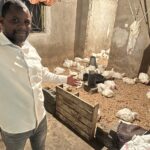
Now Boyd and his wife still have four children at home: Blessing 19, Promise 15, Shakinah 13 and Melchizedek 7. They have taken in an additional six children- including some neighbors and relatives. They have a room for the boys, a room for the girls, their own room, and two rooms full of 370 chickens!
We first became aware of his home-based chicken farm when he and his wife invited to a meal on our second visit to Zambia. While eating fried chicken in his living room with our team we could hear peeping and smell chicken manure. He gave us a tour of his house, showing us two large bedrooms full of chickens.
He shared how he’s used the money to help some of the neighborhood children and children of his pastors cover their school fees. He used money from the sale of chickens to pay for 1000 cinderblocks to build one of his churches and to help his oldest daughter Catherine go to medical school. Last month 340 of his latest brood of 370 chickens died when floodwaters filled his home, requiring them now to seek new housing on higher ground (see video below). Boyd tells me he’s not worried.
“I am confident that God will provide,” he says with a smile. “These experiences are a school where we learn—like the children of Israel were taught by God in the wilderness.” Boyd is experiencing firsthand Psalm 25:9, “He leads the humble in justice, and he teaches the humble his way.”
He plants corn and other crops to feed his family. He’s won the trust of hundreds of church leaders from many denominations, which was evident when he hosted our first Zambian Certificate in Holistic Liberation that 400 pastors attended. Each evening after full days of teaching, Boyd took us to preach and minister to the churches he started.
These churches are humble structures with walls sometime made of adobe, and other times much simpler frames with plastic bags to keep out the wind. Several of the churches did not yet have roofs—as in Prayer Tower pictured below.
While Boyd and his people are certainly the meek who Jesus speaks about in the Beatitudes, they are not yet visibly inheriting the earth. They are experiencing provision, training and growth in their families and faith communities. They certainly look like they are in line to be beneficiaries of the promise of Psalm 37:11 “But the humble will inherit the land and will delight themselves in abundant prosperity.”
God opposes the proud
In contrast, God’s opposition to the proud is less visible in these dark times here in the USA and elsewhere. The rich and powerful are amassing riches at an accelerated rate. Powerful political leaders appear to be getting away with levels of deception, corruption, lawlessness, killing, and abuse of power like I’ve never seen.
It seems we are now witnessing firsthand Psalm 73 incarnate at the highest levels of government and business.
“I saw the prosperity of the wicked. For there are no pains in their death, and their body is fat. They are not in trouble as other men, nor are they plagued like mankind. Therefore pride is their necklace; the garment of violence covers them. Their eye bulges from fatness; The imaginations of their heart run riot. They mock and wickedly speak of oppression; They speak from on high. They have set their mouth against the heavens, And their tongue parades through the earth” (Psalm 73:3-9).
Secretary of War Pete Hegseth has expressed repeatedly his belief that naked power, lethal force is good and necessary. In his speech before top military officials in September 2025, he boasted:
“We unleash overwhelming and punishing violence on the enemy. We also don’t fight with stupid rules of engagement. We untie the hands of our warfighters to intimidate, demoralize, hunt, and kill the enemies of our country. No more politically correct and overbearing rules of engagement…. “Should our enemies choose foolishly to challenge us, they will be crushed by the violence, precision, and ferocity of the War Department.”
Over the past month the Trump Administration has launched drone attacks against fishing boats off the coast of Venezuela that have killed over 100 people and seized oil tankers. This week the US military then attacked Venezuela, taking its President Maduro and his wife by force to face criminal charges in New York. This was followed by declarations that the US will run Venezuela and seize its oil. Shortly after President Trump threatened to attack Columbia and boasted of taking Greenland for the US. This was followed by the brutal killing of a woman by an ICE agent during raids following a massive deployment of federal agents in Minneapolis on Wednesday.
One of President Trump’s tops aides, Stephen Miller responded to Jake Tapper of CNN this Monday regarding events in Venezuela and threats against Greenland with a statement that goes directly against the prophet Zechariah famous words in Zechariah 4:6: “Not by might, nor by power, but my Spirit” says the Lord of hosts.” Said Miller:
“We live in a world in which you can talk all you want about international niceties and everything else, but we live in a world, in the real world, Jake, that is governed by strength, that is governed by force, that is governed by power. These are the iron laws of the world that have existed since the beginning of time.”
As a child I memorized Proverbs 16:18, which I still know by heart according the King James Version: “Pride goeth before destruction, and a haughty spirit before a fall.”
Wouldn’t this verse alone cause anyone claiming to take the Jewish and Christian Scriptures seriously to stop supporting prideful and haughty leaders?! I took to heart the strong warning in this proverb, which reminded me to be vigilant over my heart. Alerted to devastating consequences of pride and a haughty spirit – “destruction” and “a fall,” I found myself noticing it to such an extent that it often kept me from trusting anyone seemed prideful of haughty.
This verse alone serves as a basis for discernment as to whether anyone should pursue making America great again. National pride, racial pride, or any kind of pride and boasting is a set up for destruction and a fall. How could people who claim to follow Jesus of Nazareth ever follow celebrities or politicians who are blatantly prideful and haughty?
Psalm 73 ends with declarations regarding the fate of the powerful that should make anyone aligned with them jump ship, not remain silent and resist by aligning more fully with Jesus now:
Surely you set them in slippery places; You cast them down to destruction. How they are destroyed in a moment! They are utterly swept away by sudden terrors!” (Ps 73:18-19).
The promise of Scripture is that God “scatters those who are proud in the thoughts of their heart, brings down rulers from their thrones and exalts those who are humble (Lk 1:51-52). This has already begun with the exaltation of Jesus, raised from the dead and seated in the heavenly realm. Jesus’ defeat of death on the cross and exaltation is our assurance that the meek and humble of the earth will follow.
I see signs of God’s raising up the humble in the witness of people like Bishop Boyd in Zambia. His plans this year include starting anew his chicken-raising project, increasing his small goat herd of seven to 150 so he can build still more faith communities. He is welcoming us to teach the second module of our Certificate in Holistic Liberation to 200 pastors in NW Zambia at the end of March. He will himself teach courses with us to humble pastors and church leaders in Malawi and Mozambique in April.
Boyd is like many other humble Jesus followers actively advancing King Jesus’ kingdom under the radar of empire. This is a victorious kingdom that cannot be stopped, which will advance until final victory upon Jesus’ return. This is my hope in 2026 and beyond.
If you would like to contribute to helping Bishop Boyd’s chicken-raising project and training of pastors you can make a donation in the following ways:
Go to www.tierra-nueva.org and click on “Donate” (https://www.tierra-nueva.org/donate). There you will find a dropdown menu where you can designate your gift. All gifts from US donors are tax deductible. You can also mail a check to:
New Earth-Tierra Nueva
PO Box 410
Burlington, WA 98233
If you live in the UK you can give through our account at Stewardship. Click here to set up your sign-in details.
Check out Bob’s most recent podcast “Disciple: Word, Spirit, Justice, Witness” below– “What does it look like to live by faith?”
Joining Jesus in his mission to raise up the poor and needy
“Who is like the Lord our God, enthroned on high, who humbles himself to see” all of us here on the earth?” (Ps 113:5-6). “He raises the poor from the dust and the needy from the ash heap, making them sit with princes” (Ps 113:7-8). Jesus embodies this humbling of himself and compassionate way of seeing. He invites us as his disciples to join him.
Paul invites us to “have this attitude in yourselves which was in Christ Jesus, who though in the form of God he emptied himself, taking the form of a servant, and being made in the likeness of men, he humbled himself by becoming obedient to the point of death, even death on a cross” (Phil 2:6-8).
What does it look like for us to join Jesus in humbling himself and raising up the poor and needy? We can start by trying to consciously notice who we notice. We can take another deliberate step by asking Jesus who he wants to raise up, how we can initiate contact, and where to go from there. As we do this, we enter a process of mutual transformation alongside whomever we’re drawn to.
As we approach a person we remember to treat them with the highest respect—not offering a fix, pressuring them to do anything or even a suggestion of any kind of a solution.
Attunement to our own anxiety and consciously receiving the love and peace of Christ for ourselves helps us pass on that love and peace as we talk or sit with someone. Sitting with people in their pain, listening to them, refusing judgement or any agreement with self-accusation will establish trust.
When a person trusts us enough to share their story, we hear details that begin to give us a picture of their lives that will change ours. Lately I’ve been seeing many who fit in the category of poor and needy stuck in a low place, seemingly blocked from being lifted up.
Often the poor and needy are themselves rescuers who have been used and even preyed upon by people they’ve tried to help. Other times they’ve been the objects of countless rescue efforts. Some have been abandoned repeatedly as unredeemable. Their failures to rescue others (or be rescued) have left them feeling like failures. Many are stuck in emotionally anguish, suffering psychological and physical pain born of deprivation, abuse and other traumatic events. Many people turn to alcohol and drugs to ease their pain, which has led to incarceration, homelessness and criminal lifestyles.
People often feel unworthy of being lifted up by anyone, including God, because they blame themselves for their failures. They may feel shame for sacrifices they’ve made for others that were not acknowledged or successful—or for other people’s failed sacrifices.
They may have internalized guilt, blame and shame that have gone so deep, resulting in low self-esteem and even self-hatred, sometimes leading to self-harm, overdose and suicide attempts. As we hear people’s life stories, we may begin to see our own story with new eyes.
We may find that people are punishing themselves, refusing God’s elevation. As we encounter people in these states, we may see that we ourselves are in a similar place, rescuing others as a kind of subconscious penance, a way to feel better about ourselves– rather than from a place of truly knowing God’s unconditional love and acceptance.
We may find that we identify with people’s refusal to let Jesus raise them up—because we too are refusing this for ourselves. We feel more comfortable being down with those who are down—as we subconsciously believe this is what we deserve. This may be why we are drawn to the poor and needy—because we identify with them. We too are poor and needy. Are we too in need of Jesus to raise us up?
We may come to see that we, like those we seek to raise up, are out to save others. We may learn that we do this out of a kind of rescuer identity that we learned in our family of origin—and not always (or rarely) because Jesus sent us. Will we let him save us and send us? Or do we feel too uncomfortable on the receiving end of Jesus’ saving love? Maybe we are afraid to let him love us into a new identify that we are not familiar with, that we feel we don’t deserve.
Are we afraid of elevation? Many people don’t want to be seen as better. Some of us already feel like people see us as better than them. We may wonder whether certain people think we secretly think that we are better than them— and some may not be able to imagine that we see them as equal or better.
And then there is survivor guilt. We feel we must now work hard helping others at risk, in order to justify our own existence. Some of us may think: “To the one who has been given much, much is required.” We cannot rest. We drive ourselves to the point of burnout, exhaustion, ill health, death…
People (myself included) are often more comfortable being down and staying down– afraid to let themselves be loved, forgiven, and elevated. We come to see that the poor and needy struggle to receive God’s powerful, unconditional love. But we see too that we ourselves have the same problem! As we seek to lift someone up who is resisting our love, we come to see that we too need to receive Jesus’ love for ourselves. In fact, if we don’t, we will have nothing to give.
We encounter people who do not seem to want to be lifted up, as it would mean leaving their comfort zone— a place with others like themselves where they have a sort of community. Or a place of co-dependency where they are used, rejected, stomped on, and in other ways mistreated—which strangely they may feel they deserve.
As we serve and encounter resistance, we see that we need to invite certain people to flee their downtrodden state. But when we see them resisting, we wonder whether they maybe haven’t yet bottomed out—to the point of saying:
“I’m done!— with sacrificing myself (often for others) as my core identity to the point of self-harm. Now I finally surrender to Jesus and accept his unconditional acceptance!”
People who are downtrodden need to hear how and why they are beloved, valued, and precious in God’s sight just as they are. This message will be more believable if it is delivered by someone who has deeply received it and believed it for themselves! The messenger must themself receive a message inspired by the Creator—who alone knows the messenger and the receiver fully. It is only the Spirit who can reveal a life-giving message that is tailor-made for each person.
“For to us God revealed through the Spirit; for the Spirit searches all things, even the depths of God. For who among people knows the [thoughts] of a person except the spirit of the person which is in him/her?” (1 Cor 2:11).
When our message is inspired by the Holy Spirit, it will more easily be received through faith by the hearer.
This message must be embodied by someone who shows God’s love through physical presence and other concrete acts of service, advocacy and words. Through our respectful, dignifying presence people can experience their belovedness.
When someone chooses to trust us, to open their heart and receive from us, something sacred happens. We experience what Jesus tells his disciples: “The one who receives you receives me, and the one who receives me receives him who sent me” (Mt 10:40). This experience of mediating the Divine Presence is what we are created for. But as John the Baptist was not himself the light, but bore witness to the Light (Jn 1:7-8), we too are not the Savior. We point away from ourselves to Jesus, to whom people can directly connect with themselves.
Another person’s faith cannot be sustained if it is only placed in us, our church or organization. We cannot be there for people 24/7. Human saviors will always be inadequate—creating unsustainable dependency that finally disappoints. The living, resurrected God—Jesus, is who they (we) need. He alone can bring them up and out of their darkness and chaos into a new place where they can experience the fullness of life.
Being raised up by Jesus happens when we open ourselves to letting him love us 100%, forgive us for all our offenses, receive his offer of unconditional acceptance, and accept the Holy Spirit to comfort, empower and guide us into our truest vocations as active participants in his mission. We can step into his movement now, which includes a promise of provision and eternal security as we seek first his kingdom and righteousness. We are offered continuous spiritual formation as he continues to teach through his Word and Spirit.
Let us join Jesus in his raising up the poor and needy, which starts by letting him elevate us! As we surrender to God’s love may we learn to love ourselves as God loves and cares for us— mind, body and spirit. Let’s seek a lifestyle that models what we hope for those we seek to raise up: Getting enough rest and exercise, eating well, spiritual practices and study that sustain us, and even going on vacations!
Jesus wants you and me to join him in his mission—a global mission that involves making disciples who will continue the work of raising up the poor and needy. As you abide in his love you will have the strength to endure—to bear fruit for his kingdom, entering into his eternal joy.
God’s action in history elevates the poor and brings down the powerful: A reflection on Psalm 113
In these times when billionaires are visibly amassing wealth, politicians are bowing before their powerful shot callers, the world’s most vulnerable people and creatures are under assault, Psalm 113 tells us of the higher, unstoppable reality of the Creator’s agenda, which we are invited to contemplate and join.
Praise is called for, to the Master of the universe, in the face of impending darkness.
“Praise, O servants of the Lord. Praise the name of the Lord. Blessed be the name of the Lord from this time forth and forever. From the rising of the sun to its setting the name of the Lord is to be praised. The Lord is high above all nations; his glory is above the heavens” (Ps 113:1-4).
The Psalmist then offers surprising reasons for this call to worship, asking:
“Who is like the Lord our God, who is enthroned on high?” (v. 5).
We don’t yet know if anyone is like the Lord— until we read the next very un-demigod-like description (quite unlike modern day authoritarians!) of God in the second half of the question:
“Who humbles himself to behold the things in the heavens and in the earth.”
The God here, called Lord (the divine name in Hebrew, YHWH) is “enthroned on high”—that is, in the place of the highest governing power. Yet this God humbles himself—something unheard of for a powerful sovereign—and especially for God (the way many view God).
The Hebrew verb shaphal is sometimes translated here “he stoops down”- which portrays someone who is still standing above (enthroned in heaven), bending forward. I wonder whether translators choose “stoop” because “humbling himself” when applied to God may have seemed to some as going too far, sounding even scandalous. Yet the meaning also includes “being abased” and “low,” and a related word applied to geography. Shephelah means “lowlands”— inviting us to contemplate a truly humble God.
God goes low, humbling himself “to see”– the best translation of the underlying Hebrew raah. And what does God see when God comes low?
There’s no mention of God seeing “the things”—which is added into many translations. The Psalm in fact literally reads “to see in the heavens and in the earth.” The “in” can be translated “in,” “inside,” or “within”—inviting us to contemplate God seeing quite deeply, even intimately. Who God sees shows God’s lowliness, which becomes clearer in the next line.
“He raises the poor from the dust and lifts the needy from the ash heap” (v. 7). God sees the poor and needy—the victims of our racial and class divisions, violence and oppression. God’s seeing involves direct action—as God is looking towards the new heavens and the new earth. Do we see who God sees? Are we joining God in this proximity to the lowly?
God sees the poor in the dust and does not leave them there. God raises the poor up and out of their deprivation. God lifts the needy up and away from the ash heap. The term “raise up” in the Greek version of Psalm 113 means “to get up” (Mt 9:6,25; 17:7), and to be raised from the dead (Mt 11:5; 17:23; 20:19). God lifts up the needy, and the verb used in the Greek version, anuphoo, means “to lift up, be extolled, made tall.” God raises and lifts up “to make them sit with princes, with the princes of his people.”
This is hard to understand— as this movement is the opposite of what we now see accelerating in our world. These days the rich and powerful are distancing themselves further and further from the poor and marginalized— whom they often exploit, oppress and scapegoat. Here in this vision of the new heaven and new earth, the poor and needy “sit with” and not “work under” or “for” the princes/rulers—and they are not incarcerated or deported by them!
Here in the Greek version, “princes” designates non-human powers, as in Ephesians 6—which states that “our struggle is not against flesh and blood, but against “rulers” (archon).
God’s work here is to raise up the poor and needy and make them sit with princes, erasing the historic distance by bringing equality. Mary’s radical song when pregnant with Jesus, the “Magnificat,” appropriates Psalm 113 and Hannah’s song (1 Sam 2), announcing judgment of the powers. She prophesies God’s scattering of the proud, bringing down rulers, reversing the fortunes of the rich– and lifting up the humble to an even higher place, and filling the hungry.
“He [God} has scattered those who were proud in the thoughts of their heart. He has brought down rulers from their thrones, and has exalted those who were humble. He has filled the hungry with good things; and sent away the rich empty-handed” (Lk 1:52-53).
The Psalmist calls God’s people to worship the God who is unlike any god. This God humbles himself to see, and to raise up the poor and needy— inviting us to do likewise. We are now called to resist the movement of human history around us in confident hope in God’s final victory, in alignment with Jesus and his kingdom.
We are invited to see as Jesus sees, who upon “seeing the people, he felt compassion for them, because they were distressed and dispirited like sheep without a shepherd” (Mt 9:37).
We are invited to hear with Jesus’ disciples his call, and to respond: “The harvest is plentiful, but the workers are few. Therefore beg the Lord of the harvest to send out workers into his harvest” (Mt 10:37-38).
Black Lives Still Really Matter! Spotlight on Sudan
The news media keeps our attention on issues of varied importance, while chronically focussing less attention on mass killings and starvation fueled by US companies and allies that affect people considered of lesser value– such as Black (Sub-Saharan) Africans.
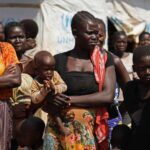
Currently a genocide is underway in Sudan that goes largely unreported by the mainstream media. An estimated one hundred and fifty thousand people have been killed since the conflict began on April 15, 2023. More than fourteen million have been displaced (see this).
The RSF rebel group responsible for the worst atrocities is covertly backed by UAE (United Arab Emirates), who claim they are only offering humanitarian aid. But reputable reports show that the UAE is working with the rebel group responsible for mass killings, who control gold mines that interest the rich and powerful (have you noticed what’s happening with the price of gold?!). See this article and this one.
US defense contractors have been largely supplying the UAE, especially since President Trump and his tech billionaire partners met with Arab leaders and agreed to sell the UAE $1.4 billion worth of military aircraft and equipment (read this).
Recent mainstream articles emphasize the UAE’s supplying the Sudan rebel group with Chinese drones (which is the case), obscuring the fact that US companies such as Lockheed Martin, Raytheon Technologies Corp. Boeing and General Atomics have been enriching themselves. May we keep our eyes and ears open so we can pray and act intelligently for the preservation of life– exposing injustices and advocating for victims, as the Spirit guides.
Below is a appeal written by our dear friend Jennie Telfer, whose Sudanese husband Malik’s family is directly affected by the civil war. Please prayerfully consider Jennie’s appeal.
Dear Friends,
With the news coming out of Sudan, it’s been a long and emotional week. So, I’ll lament a bit below… if you’ll bear with me.
El Fasher is a city in Sudan which has been under siege by the Rapid Support Forces for over 500 days. The siege was so severe that people were starving to death. The US and many European nations decided to reduce their humanitarian aid and development funding this year (image with details attached) – while increasing their military budgets. Funds that were used to keep alive the malnourished – preventing the war-induced, man-made famine in Sudan from killing more people – all dried up earlier in the year.
El Fasher fell to the RSF last weekend – two days after the Sudanese Army retreated, abandoning the civilians to a genocidal militia. The RSF moved in and, as expected, have been killing civilians en masse – including over 400 people at a MATERNITY hospital. The blood and piles of bodies are visible in satellite images. Cell networks have all been shut down, but using starlink access, the RSF has been uploading terrible videos of their war crimes. Before the war broke in 2023, El Fasher was a city of over 1 million people. At the time it fell to the RSF, there were an estimated 220,000 people there. We have no idea how many souls were lost to the RSF slaughter.
This is personal ~ Malik’s family is living in locations under occupation or siege by the RSF… all suffering from the man-made famine of this war… three pregnant sisters… lots of young nephews and nieces whose growth is being stunted by malnutrition and whose lives are all still at risk by this genocidal militia.
The RSF’s violence is backed by the United Arab Emirates (UAE- aka, Dubai, Abu Dhabi) – who has been providing weapons and trafficking foreign soldiers to fight for the RSF since the beginning of the war. The UAE is trying to exploit the natural resources of Sudan- stripping Sudan of its natural wealth at the cost of Sudanese lives. Despite US and UN intelligence verifying that the UAE is backing the RSF with weapons – and despite the US designating the RSF violence as genocide – the US and Canada continue to sell weapon systems to the UAE. US weapons and Canadian armored vehicles (produced by Streit Group) are being used in Sudan. I can’t adequately express the devastation in knowing my government and my tax dollars are contributing to the destruction of our family there.
To add insult to injury, the US and Canada are shut off to any Sudanese refugees. The Canadian government veils its racist refugee resettlement by imposing bureaucratic delays for Sudanese (I keep hearing of Sudanese people dying while waiting for the Canadian government to respond to their requests to take refugee with their own families in Canada); the US does not veil its racism at all – putting a blanket travel ban on any Sudanese visa applicants while reducing refugee numbers by 94% and prioritizing the 7,500 refugee spots now available for White South Africans. The racism and the complicity in Sudanese death is too much.
I have a few requests for you:
1 – Please keep your eyes on Sudan, bear witness to their suffering, and pray for them.
2 – Please ask your friends and faith communities to pray for peace in Sudan, too. Please do so openly and publicly.
3 – If you have any extra funds, please share with grassroots groups trying to pick up the pieces dropped when our governments stopped sharing with the world’s hungry. Here are a few groups needing emergency help: www.tinyurl.com/SudanFamine
4 – Take action to boycott the UAE, tell our governments to stop sending weapons to the UAE, encourage an arms embargo on Sudan, and protest racist refugee resettlement policies. Click here.
Sincerely grateful to any of you who don’t look away,
Jennie 김수정
Mobilizer & Conflict Transformation Trainer
Peace Catalyst International
The People’s Seminary is breaking new ground in Malawi and Mozambique
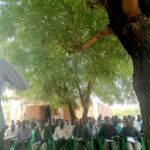
Today our African teaching team of seven began a training for 180 pastors and church leaders in a remote region of Mozambique. The five-day course is taking place under the shade of a huge Mukina tree– with temperatures reaching 107 degrees F (42 C).
The photo above reminds us of The People’s Seminary’s origins in Honduras– where courses took place under huge mango trees. We even called it “Universidad Bajo Los Mangos” (photo below).
Then and now we were impacted by Scriptures like Luke 4:42, telling how Jesus left towns and went into the wilderness, where the crowds searched for him. Jesus taught ordinary people outdoors, where they spent most of their time– on mountains, along the road, by the seashore. This inspires us.
In Honduras we trained and sent out local people as trainers– something which we are now also doing in Africa.
Why Africa? We never imagined that we would leave Central America at the height of our work there. But the political climate in the 80s made it impossible for us to stay. Then there was a huge exodus of Hondurans in search of work in the US. At the same time the African harvest became plentiful, and the workers are…still few.
What a joy to hear reports of people who eagerly attend our five-day module 1 training: “Identity, Liberation, Healing, and Mission.”
Pastor Uritta, one of our teachers from Zimbabwe (pictured with a black purse) reports:
“We had a good number of audience who were so engaged in the teachings and were participating in the discussions contributing and asking questions. We desire to see leaders gain knowledge, being healed and being transformed so that they lead healthy churches.”
Six of our teachers made their way to Malawi and now Mozambique from three countries. Boyd and Christopher took the two-day bus journey from Ndola, Zambia. Richard, Elizabeth and Uritta came by bus from Gueru, Zimbabwe. Colleen came the furthest by plane from Cape Town. There they joined our hosts Kelvin and team to offer the first week of training in Malawi.
Last week 200 pastors and church leaders met under tents in a rural village to receive the teaching over five days. Uritta, who taught on healing from father and mother wounds, ministry protocol, and praying for healing and deliverance writes:
“The seminar was impactful and inspiring. I was so overjoyed seeing people’s lives touched and impacted. The atmosphere was great and the team spirit was amazing.The team members were excellent in their presentations which l learned so much from and grew spiritually, deepening my faith as well.”
The People’s Seminary provided a 200-page manual translated from English into Chichewa for each participant (pictured with Kelvin below).
We are shocked and saddened to hear that most of these pastors do not have a Bible in their language (or any language). In our last training in Malawi we were able to purchase and distribute 200 Bibles to the participants. We would like to be able to purchase 380 Chichewa language Bibles from the Malawi Bible Society at $10 each to distribute to these new course participants in Malawi and Mozambique.
In the meantime we continue to teach with the manuals, using Bibliodramas– inviting response and praying for people during ministry times.
Elizabeth teaching with Mozambican translator
We are now preparing to offer our Certificate in Holistic Liberation in the Democratic Republic of Congo and Cameroon, and to offer Module 2 in Lesotho, Benin, Zambia, Malawi and Mozambique in 2026.
We welcome contributions towards Bibles or course expenses online here, or through sending a check to Tierra Nueva (Attn: The People’s Seminary), PO Box 410, Burlington, WA 98233, USA.
UK donations can be given through our account at Stewardship. Click here to set up your sign-in details.
Please hold our African trainers and the course participants in your prayers this week as they travel long distances daily and teach in sweltering heat.
Consider signing up for a self-paced Certificate in Holistic Liberation, which involves watching weekly videos, following a manual and meeting online on the first Monday of each month (10:00-11:30am PST) with participants from around the world (scholarships available). Check it out and sign up here.
Check out my podcast “Disciple: Word, Spirit, Justice, Witness” on Apple or Spotify.
Submission as Resistance: Romans 13 in the light of Jesus & Psalm 2, vs. Charlie Kirk’s memorial service
The prophetic witness of Christians before the State has too often been muted by a surface reading of the Apostle Paul’s words in Romans 13:1-7, with its infamous “Every person is to be in subjection to the governing authorities. For there is no authority except from God, and those which exist are established by God” (Rm13:1). And further on:
“But if you do what is evil, be afraid; for it does not bear the sword for nothing; for it is a minister of God, an avenger who brings wrath on the one who practices evil” (Rm 13:4).
Added to this are Peter’s words: “Submit yourselves for the Lord’s sake to every human institution, whether to a king as the one in authority, or to governors as sent by him for the punishment of evildoers and the praise of those who do right” (1 Pet 2:13-14).
It is critical that we read these verses about submission and the sword in their larger contexts and in the light of Jesus’ and the Apostles’ missionary activity and teaching.
A uniquely Jesus-inspired form of submission and resistance is clarified when you include Scriptures about governing authorities, like Psalm 2, Revelation 13 and others in the discussion.
We need the full witness of Scripture to inform our thinking and actions in these challenging times. Looking closely at Jesus’ witness and teaching helps us discern and reject false ways of appropriating Romans 13, as in the following example.
On September 21 at Charlie Kirk’s memorial service the American political commentator and YouTuber Benny Johnson evoked Romans 13.
“In Romans 13, the Apostle Paul talks about a godly government instituted by our Lord and Savior. And what does he describe? The Apostle Paul describes how God establishes the rulers of the nations” he said.
Johnson than motioned over to his left, where Donald Trump and his cabinet were seated and continued.
“In the audience right now, there are rulers of our land. Represented right here is the State Department, the Department of War, the Department of Justice, the Chief Executive. God has instituted them. God has given them power over our nation and our land. God saved our president, President Trump, from an assassin’s bullet, for this moment. And what does the Apostle Paul in Romans say about a godly leadership? He says that rulers wield the sword for the protection of good men and for the terror of evil men.”
Here Benny Johnson inserts “godly leadership,” which Romans does not state. He goes further still by calling people to pray that the Trump Administration would use violence to terrify (not love) enemies.
“May we pray that our rulers here, rightfully instituted and given power by our God, wield the sword for the terror of evil men in our nation in Charlie’s memory. I want to live in a country where the evil are terrified and where the good and the faithful and the moral people of our nation can live in peace, debate in peace, disagree in peace and start families in peace. And so we want to thank the administration for being here and carrying out that godly mission of wielding the sword against evil.”
Johnson and many other speakers after him, (including numerous cabinet members), equated the Trump administration with Jesus and the Kingdom of God in ways that Jesus himself, Paul and Peter would never have endorsed.
Rulers are also presented in Scripture as bearing the sword for evil—as when Herod Antipas, the Roman tetrarch had John the Baptist beheaded (Mt 14:10), or when King Herod Agrippa beheaded James the son of Zebedee (Acts 12:2). Old Testament prophets spoke out strongly against Israel’s kings, and often were persecuted, incarcerated and executed.
Jesus himself never sought political power. After Jesus multiplied loaves and fish and fed 5,000 people, they tried to take him by force to make him king. He withdrew to the mountain.
When Pilate asked Jesus if he were a king he replied: “My kingdom is not of this world. If my kingdom were of this world, then my servants would be fighting so that I would not be handed over to the Jews; but as it is, my kingdom is not of this realm” (Jn 18:36).
Here Jesus states clearly that he and his servants would not be about self-defense, the right to bear arms, or about fighting for an earthly kingdom.
Right before turning him over to be crucified Pilate pressed Jesus further regarding his identity, asking him: “So You are a king?”
“Jesus answered, “You say correctly that I am a king. For this I have been born, and for this I have come into the world, to testify to the truth. Everyone who is of the truth hears my voice” (Jn 18:37).
What is often missed is that Jesus, Paul and Peter called believers to submit to the pagan and brutal Roman Empire—and not to an idealized theocratic state. Submission included respecting the rule of law, so long as obedience to human authorities did not counter the higher allegiance to Christ.
For Peter, who addresses his epistle to “those who reside as aliens” (1 Pet 1:1) and “aliens and strangers” (1 Pet 2:11), this meant honoring 1) all people, 2) loving fellow believers, 3) fearing God, and 4) honoring the king, in that order (1 Pet 2:17).
Submission to authorities meant humbly accepting the consequences if disobedience were required. Jesus, Peter and Paul were all arrested, beaten, and imprisoned for their missional activities, and Paul wrote at least four of his Epistles from prison.
Yet Paul still viewed all categories of rulers and authorities governing the world as part of the originally good creation, made by Christ:
“For by him all things were created, both in the heavens and on earth, visible and invisible, whether thrones or dominions or rulers or authorities — all things have been created through him and for him” (Col 1:16).
These non-human entities were viewed as subsequently fallen and rebellious, as the beast which Revelation 13 graphically portrays– but still in operation until the end.
So, Paul and Peter are calling for Christians to be in a particular kind of willing subjection to whatever government or political party is in power— whether that be a democracy, a caliphate, a fascist dictatorship, a monarchy or maybe even a mafia or gang network that rules a failed state.
Paul and Peter were recommending a course of action so that new believers who were often poor and vulnerable, and fragile new faith communities could survive and advance in hostile terrain, while simultaneously bearing witness to Jesus.
“If possible, so far as it depends on you, be at peace with all people” (Rm 12:18).
Their counsel is in part like advice given to prisoners serving a prison sentence, or to people on probation or engaged in drug court who must obey the rules to avoid further trouble.
Paul appears to have often considered governing authorities his enemies, writing strong words regarding enemy love right before Romans 13:
“Bless those who persecute you; bless and do not curse.”
He ends Romans 12 with “do not be overcome by evil, but overcome evil with good.” (Rm 12:14, 21).
So, Paul and Peter’s words must not be read as religious endorsements of State power in ways that promote a cozy alliance between religious and secular leaders—and certainly not as promoting a Christian government or agendas like “America (or any nation) First,” or “Make America Great Again.” Secular authorities, governments, and nation states have their specific role. But they are not equated with the Kingdom of God!
Jesus, Paul, and Peter called for allegiance to God as the highest power:
“You shall love the Lord your God with all your heart, and with all your soul, and with all your strength, and with all your mind, and your neighbor as yourself” (Lk 10:27).
Nor do these texts mean that Christians must obey laws that go against conscience, be silent about injustice or hold back from their highest callings as Jesus’ disciples.
Jesus resisted religious authorities when he healed on the Sabbath, cleansed the Temple, and strongly critiqued Jewish leaders. Peter and Paul disobeyed orders to not preach in the name of Jesus, and willingly suffered the consequences: imprisonment (Acts 4:1), beatings (2 Cor 11:23), and execution (Acts 7:58-60; 12:2). The first Christians refused military service and worship of Caesar as Lord and suffered torture, imprisonment, and execution.
Jesus’ revolutionary submission
Jesus models a quiet authority and confidence before the Roman governor of Judea Pontius Pilate, after he informed him he had authority to release him or crucify him with: “You would have no authority over me, unless it had been given you from above” (Jn 19:11)—ultimately from himself!
The Apostles saw Jesus’ subjecting himself in self-giving love on the cross as the deathblow to the ruler of this world– the beginning of the end of the reign of the rulers and authorities, which will be judged and finally destroyed (1 Cor 15:24-27).
Jesus warned his disciples then and now that his same fate can be expected at the hands of authorities.
“But beware of people, for they will hand you over to the courts and scourge you in their synagogues; and you will even be brought before governors and kings for my sake, as a testimony to them and to the Gentiles” (Mt 10:17-18).
In this time before the end of history Paul wrote: “For our struggle is not against flesh and blood, but against the rulers, against the powers, against the world forces of this darkness, against the spiritual forces of wickedness in the heavenly places” (Eph 6:12).’
Romans 13 and 1 Peter 2 must also be read in the light of Psalm 2, which begins by asking a question that Christians in America and in many other nations should be asking:
“Why are the nations in an uproar and the peoples imaging a vain thing?”
“Why do we as Christians get so caught up in endorsing political candidates and parties, mirroring the hate-filled political divisions around us?”
My sense is that many Christians are not adequately informed about the final destiny of the powers and our own unique prophetic vocation.
The Psalmist reminds us of the macro divine perspective: “The kings of the earth take their stand and the rulers take counsel together against the Lord and against his anointed” (Ps 2:2).
Jesus experienced hostility from rulers and authorities, and prophesied his followers would experience the same (Mk. 13:9; Lk. 12:11)– which they did (Acts 4:5). Martyrdom was normative then and is on the rise now.
Christians are called to be subject to governing authorities not because they are good or represent God’s agenda. Our citizenship is in heaven. Peter urged believers to see themselves as “aliens and foreigners” right before his words about being subject to authorities, who he sought to evangelize:
“Keep your behavior excellent among the Gentiles, so that in the thing in which they slander you as evildoers, they may because of your good deeds, as they observe them, glorify God in the day of visitation” (1 Pet. 2:11-12).
Christian submission to rulers and authorities must be done from a perspective of open-eyed realism about both the rebellious, hostile orientation of the powers against the reign of God and Jesus’ greater sovereignty and victory.
“He who sits in the heavens laughs, the Lord scoffs at them. Then he will speak to them in his anger and terrify them in his fury, saying, “But as for me, I have installed my King upon Zion, my holy mountain” (Ps. 2:4-6).
Jesus is that King, the Son of the Father, come to open the way for us to receive our authority and receive our inheritance as daughters and sons.
“I will surely tell of the decree of the Lord: He said to me, ‘You are my Son, today I have begotten you. ‘Ask of me, and I will surely give the nations as your inheritance, and the very ends of the earth as your possession” (Ps. 2:4-8).
Jesus was installed “King of the Jews” there on the cross. Jesus’ submission to rulers and authorities to the point of death on the cross was God’s secret weapon against Satan and the rebellious powers.
God “disarmed the rulers and authorities, he made a public display of them, having triumphed over them through him [Jesus]” (Col 2:15).
Paul understood that the way of Jesus, the cross is how death was defeated– though the rulers who bore the sword were ignorant of what they were doing:
“For if they had understood it they would not have crucified the Lord of glory” (1 Cor 2:8).
The Psalmist’s prophetic warning is still in force, putting all Christian submission and resistance into the larger context of Christ’s victory and destruction of the non-human powers.
‘You shall break them with a rod of iron, you shall shatter them like earthenware. Now therefore, O kings, show discernment; Take warning, O judges of the earth. Worship the Lord with reverence and rejoice with trembling. Do homage to the Son, that he not become angry, and you perish in the way, for his wrath may soon be kindled. How blessed are all who take refuge in him!
Psalm 2 brings hope to Christians subjecting themselves to unjust rulers as we know Jesus’ submission wins as all authorities will themselves finally submit to Jesus Christ as King. May we learn from the suffering Christ to step into long suffering prophetic witness now.
Consider signing up for my course Jesus or Nationalism? here.
Consider signing up for a self-paced Certificate in Holistic Liberation, which involves watching weekly videos, following a manual and meeting online on the first Monday of each month (10:00-11:30am PST) with participants from around the world (scholarships available). Check it out and sign up here.
Check out my podcast “Disciple: Word, Spirit, Justice, Witness” on Apple or Spotify.
The People’s Seminary in the Global South: Reflections from Benin
Gracie and I were recently in Benin, West Africa offering our Certificate in Holistic Liberation to some 70 pastors and church leaders. Our host, Segbegnon Gnonhossou (pictured below) is a professor of theology who currently lives in Seattle, where we met. He is from Benin and is so well-connected there that he was able to bring together leaders from many different denominations and organizations. He was part of our teaching team, which fits his and his wife’s calling to equip Christians in West Africa.
We had a great time team-teaching with Segbegnon, Vera Ezumah (Nigerian who grew up in France, pictured below), and Gerard Bimenyimana (pictured below), who went through our training in Burundi. Jean Raeber (from Lausanne- who went through our training in Switzerland) joined us, providing prayer & moral support.

The first thing we noticed in Benin was that people dressed in their traditional African clothing– unlike many other settings in Africa where most participants are dressed in Western business suits.
Our host told us this practice is fairly recent, and represents a reaction against the French colonial past, but also reflects people’s awareness that Benin was one of the major departure points for the Transatlantic Slave Trade, from the 15th to the 19th Century (Door of No-Return pictured below. See my video at the end).
Our Certificate in Holistic Liberation directly addresses the charge that Christianity is a European, White man’s religion, since it was largely imposed on non-white communities by dominant, White, Western colonial powers. With the rise of Christian nationalism and White supremacy in the West, many African-origin Europeans and Africans are finding it harder to identify as Christian. Instead they are often drawn to Islam or traditional religions, which in Benin includes Vodou.
We challenged this assumption that Christianity is a White man’s religion through a series of contextual Bible studies that help people discover God as creating all humans in his image and likeness from the beginning (Genesis 1-2).
Through a careful reading of the Lord’s call of Abram in Genesis 12 we talk about the pre-requisite of spiritually (and sometimes physically) departing homeland, identity markers, and family to be part of the universal mission to bless every family of the earth. We examine closely God’s action to raise up liberators like Moses, to lead people from slavery to freedom, a movement visible throughout the Old Testament prophetic tradition.
This movement reaches its most total fulfillment in Jesus, who invites us into his baptismal death and resurrection, to depart homeland and identity according to the flesh in order to join him in announcing and embodying the Kingdom of God, on earth as in heaven.
The course participants were deeply moved to see how the Holy Spirit led Philip to announce the message of Jesus to the Ethiopian Eunuch in Acts 8. It was the Ethiopian eunuch, not a European colonizer, who first brought the Gospel to Africa. This observation delighted one of the older pastors who said: “This was an unexpected gift that I’ve never heard!”
We will follow up this topic in Module 2 with teaching on resisting racism through a study in Acts 10, where Peter breaks with his exclusivist Jewish tradition to engage with pagan, Roman Centurion Cornelius.
We heard from Segbegnon that course participants in Benin felt that our training connected them to the “whole God,” enlarging their perspective away from a narrower spiritual understanding of the Christian faith.
People also commented that our holistic approach to Scripture (that included economic, social and psychological dimensions) helped expand their understanding of Jesus’ liberating message.
Our course challenged other common assumptions that create barriers for vibrant faith. People were surprised and delighted to see in example after example from Scripture that sin does not separate God from humans, who pursues sinful people with tireless love.
Over the course of the the week our team presented critiques of the prosperity gospel, the myth of redemptive violence, and our struggle against principalities and powers– manifesting in tribalism, nationalism, materialism, and sexual violence.
Participants were also moved by our sessions on healing from father and mother wounds, trauma, rejection and shame. We could see by people’s many questions that our practical workshops on how to pray for emotional and physical healing and spiritual freedom were empowering people to step out of their comfort zones with more confidence.
They commented that our emphasis on the immediacy of God as a real presence who we can expect to visit us to inspire, call and bring physical and emotional healing was especially faith-building. We learned that one of the pastors who had me call his brother to pray for his healing from cancer had previously identified as an academically-educated cessationist.
We also heard that our Bibliodramas were effective with all participants, regardless of their level of education. People were deeply impacted as they immersed themselves in the Biblical stories.
We acted out Paul’s teaching on being raised and seated with Christ (Ephesians 2:6) to demonstrate our spiritual authority to minister and pray for healing. We invite volunteers to play God the Father, Jesus and a disciple. We act out the disciple’s symbolic death in baptism, where we are subsequently raised and seated together with Christ at the right hand of the Father.
Since the Father and Jesus are invisible now, I cover their heads so only the person playing the disciple is visible– which is how we show up as God’s representatives in the world. We then invite people needing healing to receive prayer from the person playing the disciple– and see people receiving healing from different problems there on the spot– demonstrating the teaching!
During our week there in Benin we received new invitations to offer our Certificate in Holistic Liberation in the Democratic Republic of Congo, Cameroon, Ghana, and two new locations in Benin.
During the following week while we were resting in France, another team of eight African trainers (pictured below) completed the five-day Module One in Solwezi, Zambia with 185 pastors and church leaders.
Viviane Tessier teaching in Solwezi, Zambia
We returned from Benin three weeks ago to find our Tierra Nueva bank accounts so empty that we couldn’t cover our operating expenses. We praise God that we had enough to cover these trainings, and have since been able to pay our September expenses. But the future remains uncertain.
We are currently planning to send teams to offer new trainings the last two weeks of this month of October in Malawi and Mozambique. Two hundred pastors have signed up for our Course in Malawi and 80 across the river in neighboring Mozambique. These two trainings will cost approximately $8,000.00
We are uniquely positioned at this time to send African trainers fully equipped to teach church leaders in remote places who have had little to no training in Scripture and theology. The number of serious requests for our training is unprecedented, and we have so far been able to always say “yes!”
Tierra Nueva here in Washington State also needs your support as we continue to accompany people affected by immigration, addiction and incarceration. You can support us directly in the following ways:
Go to www.tierra-nueva.org and click on “Donate” (https://www.tierra-nueva.org/
New Earth-Tierra Nueva
PO Box 410
Burlington, WA 98233
If you are in the the UK you can give through our account at Stewardship. Click here to set up your sign in details.
Please hold us in your prayers as we minister at Tierra Nueva and engage in these trainings in Africa: for protection, health, strength, inspiration for us, course participants, our church people, and our families.
May God richly bless you!
Bob Ekblad