Bob & Gracie Ekblad

  • About
    • Schedule
  • Ministries
    • Tierra Nueva – New Earth
    • The People’s Seminary
    • Teaching
      • Speaking Topics
    • New Earth Refuge
  • Blog
    • Blog en Español
    • Blog en Français
  • Podcasts
    • Podcast in English
    • Podcast en Español
    • Podcast in Persian
  • Resources
    • Books and Articles
    • Talks & Lectures
    • Articles
    • Ekblad Updates
    • Bob and Gracie Ekblad’s news
  • Get Involved
    • Links
  • Contact
  • Store

Who will set me free?

05.24.19

Last Thursday night my Tierra Nueva colleague Kevin and I went into Skagit County Jail to lead a series of Bible studies. A group of four or five men from the first tier of cells called “upper Q pod” gather with us around a metal table bolted to the floor, while others watch TV, take showers or work out.

I pass out a sheet with Romans 7:14-8:3 all printed out, and after Kevin opens in prayer I invite someone to read the first verse.  One of the men reads it aloud, and I am immediately struck by both its strangeness and relevance.

“For we know that the law is spiritual, but I am of flesh, sold into bondage to sin.”

“Do we know these things?” I ask.

The men around the table acknowledge that they do in fact feel like they are in bondage. They mention addictions, old habitual ways of being, endless legal troubles and relationship impasses. Nobody sees the law as spiritual, except one man who says he sees the law as a power that crushes him. 

I explain that “the law” here Paul’s referring to is not the laws of the land, but rather God’s instructions written in Scripture that guide us, helping us choose life. God’s spiritual laws include “love the Lord your God with all your heart, all your soul, all your mind and strength, and your neighbor as yourself,” and Jesus’ call to forgive, or to love your enemies.

“Have any of you found it difficult to follow your conscience, or to practice what you think to be the best path forward, or the will of God?” I ask.  “Let’s see what the next verse says,” I suggest.

“For what I am doing, I do not understand; for I am not practicing what I would like to do, but I am doing the very thing I hate,” someone reads.

People resonate visibly with these words, talking freely about how stuck they feel, like failures when it comes to following their consciences and doing what they know to be right. As we continue to read on people seem amazed by how Paul’s words hit home, describing so accurately their experience.

“I find then the principle that evil is present in me, the one who wants to do good. For I joyfully concur with the law of God in the inner man, but I see a different law in the members of my body, waging war against the law of my mind and making me a prisoner of the law of sin which is in my members. Wretched man that I am! Who will set me free from the body of this death? Thanks be to God through Jesus Christ our Lord!” (Rom 7:22-25).

A young man beside me is particularly moved. I ask him if he himself ever feels like the wretched man that Paul describes himself to be—in need of a liberator. 

“Most definitely,” he responds, and others nod their agreement.

“Have you ever asked Jesus to help you, to set you free?” I ask.

“No, me and Jesus don’t have anything going,” he says.

“Oh really, is there any reason in particular for that?” I ask.

“I didn’t grow up in a religious home,” he says. 

“I didn’t grow up knowing anything about Jesus. This is about as far as I’ve ever gone into any of this,” he says.

I ask God for some kind of response that might get his attention, and the number 29 comes into my head.

“Are you 29 by any chance?” I ask.

“Yes, how did you know?” he asks, surprised.

“I don’t know, but I do know that when you’ve gone through your twenties, and you’ve tried living life your own way, after a lot of difficulties, failures and falls you can feel tired and at a loss for how to live your life differently” I say.

He looks stunned, and acknowledges that I’d described his twenties pretty accurately. 

“So if Jesus is described here as setting people free from being stuck in their old ways, why not give him a try and ask him to help you,” I suggest.

“Wow man, I’ve gone further with you into all this than with anyone,” the 29-year-old guy tells me. 

I ask if any of the other men had experienced Jesus setting them free in any way—and a Hispanic man across the table from me tells an amazing story of nearly drowning in the Skagit river when he was high on meth.

“I was under the water, being pulled down by a current and I came to the point of total surrender, giving my life over to God,” he recounts. “Then my leg bumped up against a log and I found the current pushing me right up and out.”

The story impresses everyone, and the men want to pray. The young man beside me wants to ask Jesus to set him free, and does.  We experience a sacred moment I find myself longing for more and more these days. 

A correctional officer calls everyone to return to their rooms, and as Kevin and I leave he suggests we can split up so one of us to cover the lower tier of Q pod, while another of us visits the men in the solitary confinement unit “M.”  I agree to stay and meet with lower Q.  

Fifteen men gather around two of the metal tables, and we read through the Romans 7 passage again. The men share openly, confessing the truth of their bondage, their inability to change, their need for a savior to free them. They resonate with the sin that resides inside them being stronger than their capacity to live as they know in their hearts they want to live. They feel the struggle and say they want Jesus’ help. 

We pray together, asking Jesus to set us free, and God’s presence has made a way once again. I leave feeling like I’m made for this, and tonight I get to go into the jail again.

Check out Gracie’s sermon this past Sunday on Romans 7 here.

Order Guerrilla Gospel: Reading the Bible for Liberation in the Power of the Spirit here.

Experiencing Native Generosity

05.17.19

These past few days I have experienced surprising generosity and gratitude from the indigenous people of our land. After planting my garden beside the river below our house I drove the car I’d used to haul compost downriver along the dike, making the loop through our neighbor’s property and back to our house.

I noticed lots of trucks parked beside the Skagit River where the Swinomish tribe launch their fishing boats during their salmon fishing seasons. I decided to stop and see if I could make contact with one of the fishermen—something I’ve done many times over the years.

As I approached a man who was busily arranging his nets, he appeared to not see me, and headed off to his car. As a white guy, I’ve experienced a mixed reception when I’ve come around the launch: indifference, resentment– and also cautious friendliness. Friendliness to white people has cost natives their land, their culture, their very lives—so I tried to approach with sensitivity to the many reasons they’d have to distrust me. I occasionally run into someone there whom I’ve met in my jail Bible studies who recognizes me and greets me warmly. Other times people are in their cars getting high and don’t want to be bothered.

I approached an older man who was arranging things in his fishing boat.

“That’s a nice boat,” I say.

“Yeah, it’s a Boston Whaler, it does the job,” he states, matter-of-factly.

“How’s the fishing? Are you fishing for Kings?” I ask.

“Yeah, we’re after Chinooks, the fishing’s ok, we’re getting a few,” he said.

Just then the other man I’d thought was ignoring me approached.

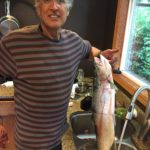
“Hey, would you like a steelhead?”

“Sure,” I said, “really?”

He motioned me over to his truck and opened a big blue plastic cooler.

“It got caught in the nets yesterday,” he said. “If you want it, I’ll give it to you.”

The man I’d been talking to in the boat yelled over to him. “Are you selling it to him?”

“No, I’m giving it to him,” he said, as he carried the shiny steelhead by its gills, walking beside me to my car.

“May God bless your fishing!” I said, thanking him for his gift. “I hope we’ll have good luck,” he said.

Yesterday, we were invited to the Swinomish blessing of the salmon fleet by Sarah, a Native American woman who attends our Tierra Nueva church and lives on the reservation ten minutes from our house.

The event, which packed out the Swinomish youth gymnasium, began with a warm welcome, followed by a drumming ceremony and then a lavish meal of seafood: smoked Chinook salmon, shrimp, crab, mussels and clams. A man approached whom I’d met in the jail, who attended our church a few years back while he was going through drug court. He came to thank me for the support we’d given him, and to tell me he’d now been clean five years.

After the meal we joined the procession to the Swinomish channel, where the ceremony was explained by the tribal chairman. Guests were honored and prayers and blessings were offered by the Catholic priest, the Assembly of God missionary and the Shaker leaders. Salmon carcasses, clam and mussel shells atop cedar boughs were held ceremonially by young people, who offered them back to the river in thankfulness to the Creator.

Gracie and I left deeply moved by the hospitality of our Native American neighbors, who hosted us, grandchildren and great grandchildren of immigrants that we are—sharing the bounty they’d harvested from this land.

To listen to last Sunday’s sermon on venturing onto Isaiah 35’s Highway of Holiness, “Step by step with Jesus,” click here.

To support our ministry with Tierra Nueva, click here.

“You enlarge my steps under me, and my feet have not slipped” Ps 18:36

05.11.19

Last week I joined three other men on a harrowing 40-mile high-Cascade ski mountaineering expedition called the Ptarmigan Traverse. I had wanted to hike this route my entire adult life. When an experienced mountaineer pastor friend of mine invited me to join him in skiing it, despite my lymphoma treatments, I jumped at the opportunity and began seriously training.

For six days beginning May 1 we traversed steep mountain slopes, climbed up and skied down high-mountain passes, and ascended glaciers. On the second and third full days we experienced unexpected whiteout conditions, requiring us to navigate almost exclusively by GPS.

Our final descent to camp atop the frozen Kool Aid Lakes at the end of day two was in the dark. I wondered how I could experience God then and there illuminating my every turn through avalanche debris-strewn slopes as Psalm 119:105 states: “Your word is a lamp to my feet and a light to my path.”

I prayed continuously as we descended and traversed, experiencing something closer to Isaiah 50:10:

“Who is among you that fears the Lord, that hears the voice of his servant, who walks in darkness and has no light? Let him trust in the name of the Lord and rely on his God.”

We were glad to make it to Kool Aid Lakes by headlamp, without falling.

On the next day the whiteout conditions continued as we ascended alongside the massive glacier on Mount Formidable. With a 60 pound pack slipping or sliding backwards felt like a major setback, and cliffs below us were not comforting. I sought to experience Psalm 17:4, “My steps have held fast to your paths. My feet have not slipped,” and experienced a kind of insecure security as we broke out above the clouds to find ourselves in a gorgeous paradise at the Spider-Formidable Col, where we made camp at 7320 feet.

The following morning we awoke to clear skies. What a relief that we were going to be able to see where we were going on treacherous terrain! We made it without incident to White Rock Lakes. However on the fourth night the wind picked up, knocking down our snow wall and thrashing our tent, and the clouds engulfed us once again. It was then that I found myself feeling an old but familiar sense of impending doom.

What was I doing on this mountain, risking my life at a time when Gracie and I are feeling like we’re in the prime of our ministry lives? I remembered how I’d surrendered my life to Jesus during a snowstorm half way up El Capitan in Yosemite in 1976, when I thought all was lost.

I recalled how clearly I felt called to give up serious mountain climbing while on the edge of Mount Blanc in France in 1978, after some 150 climbers had lost their lives in the Alps that summer. I was experiencing a higher calling, which really then did take off shortly after my final serious alpine ascents there in Chamonix at the peak of my climbing career.

Now the weather was closing in around us and I found myself repenting. “Jesus, forgive me for going back to taking unnecessary risks in the mountains, which I’d left behind to follow you. Have mercy on us! Save us! We don’t want to be navigating by GPS through potentially even more dangerous terrain tomorrow!”

On the fifth day we awoke to sunny skies and began another challenging day traversing, one person at a time, below corniced mountain ridges across avalanche-prone slopes.

That entire day as we skied across, up and over the final massive mountain pass near Dome Peak and down to another frozen lake (Cub Lake), I sought to tune into God’s words to me, as Isaiah 30:21 and Psalm 32:9 declare:

“Your ears will hear a word behind you, “This is the way, walk in it,” whenever you turn to the right or to the left.”

“I will instruct you and teach you in the way which you should go; I will counsel you with my eye upon you.”

As I followed the track up the mountain and skied down over the passes and through trees (and over trees) towards the trailhead at the end of Downy Creek, I experienced a mixture of exhaustion and delight as Psalm 17:5 was being realized: “My steps have held fast to your paths. My feet have not slipped.”

I return home with a new sense of the value of life and renewed appreciation for those I love and this adventure that continues. Tuesday night at Tierra Nueva I worshipped with our faith community, experiencing Psalm 26:12.

“My foot stands on a level place; In the congregations I shall bless the Lord.”

I continue to be aware of my need to be lead by the Spirit as we navigate our path forward every day in these complex times. May God richly bless and guide you too!


For more reflections on reading the Bible in rapport with everyday life, see Bob Ekblad, Guerrilla Gospel: Reading the Bible for Liberation in the Power of the Spirit.

To support Bob & Gracie in their ministry with Tierra Nueva and The People’s Seminary click here.


Believing in the Resurrected Jesus

04.26.19

This past Sunday we celebrated Jesus’ resurrection at Skagit County Jail and then at Tierra Nueva, followed by a community meal. Check out this podcast of Bob Ekblad’s sermon on John 20:1-18 “Believing in the Resurrected Jesus.” In this story we see how some of Jesus’ disciples came to believe he was alive in the midst of loss and grief, and how this can help us find faith now.
You can support our ministry here.

Refusing violence in favor of Jesus and his kingdom not of this world

04.19.19

In a recent trip to a 99% Muslim country, Gracie and I had the opportunity to have long conversations about Jesus with an Islamic scholar. He was fascinated by Jesus, and amazed to hear about him differentiated from Western materialism, colonialism, and American military actions. I have since found myself noticing things in the Gospels that I know would be good news to my new friend.

Peter is presented in two of the Gospels as coming against Jesus’ mission as suffering Messiah, who “must go to Jerusalem, and suffer many things from the elders and chief priests and scribes, and be killed, and be raised up on the third day” (Mt 16:21).

“God forbid it, Lord! This shall never happen to you.”

“Get behind me Satan! (Mt 16:23), says Jesus in his strongest ever rebuke. Jesus’ words here reveal that there is high-level spiritual warfare that targets Jesus’ way of defeating evil through the cross.

Have Jesus’ followers continued to rebuke Satan, the ruler of this world, as adviser behind refusals to follow Jesus’ way of redemptive suffering since his death and resurrection?  Not nearly enough!

The church built upon the old Peter (pre-Good Friday) has colluded with empires and endorsed violence (Constantine, the Crusades, colonization, slavery, modern wars, death penalty and national defense).  Jesus shows us another way.

When the authorities come to the garden in search of Jesus the Nazarene he steps forward saying: “I am he” (ego eimi)—identifying himself as the Lord who reveals his name to Moses when he called him to liberate God’s people (Ex 3:14). Jesus’ self-revelation causes his antagonists to fall to the ground. He is clear about his identity, exercising true spiritual authority through the power of the word.

In contrast, Peter steps forward with his sword. He strikes to defend a king and kingdom he wants to be then and there—of this world. He’s there to defend the innocent victim– and Jesus qualifies more than any other as a reason for “just” war. Peter cuts off the right ear of a man named Malcus, the high priest’s slave.

John’s Gospel exposes Peter’s violence as both ineffective and unjust. The victim is a slave and is mentioned by name. In John’s account Jesus does not heal him. Future readers are meant to overhear Jesus’ orders to Peter:

“Put the sword into the sheath; the cup which the Father has given me, shall I not drink it?”

Matthew’s account adds:

“For all those who take up the sword shall perish by the sword. “Or do you think that I cannot appeal to my Father, and he will at once put at my disposal more than twelve legions of angels? (Mat 26:52-53).

Peter’s violence appears to weakens him, setting him up for three denials of Jesus— and the denial of his own identity. I suggest that Christians who justify or use violence are likewise weakened, and will be prone to further denials.

In the court of the high priest Peter denies being Jesus’ disciple to inquiring servants, saying “I am not” (ouk eimi)—literally “not I am”— that is, “I am not being in my identity as a disciple of Jesus— ‘I am’.”

Once before Pilate, Jesus acknowledges that he is a king and clarifies something Peter had not understood about his kingdom:

“My kingdom is not of this world. If my kingdom were of this world, then my servants would be fighting so that I would not be handed over to the Jews; but as it is, my kingdom is not of this realm.”

Further he adds to Pilate:

“You say correctly that I am a king. For this I have been born, and for this I have come into the world, to testify to the truth. Everyone who is of the truth hears my voice.””

In too many places around the world Jesus’ disciples fall in line with Peter before his deeper conversion after Jesus’ resurrection and the pouring out of the Holy Spirit at Pentecost. May we choose to follow Jesus afresh and listen to his voice instead, renouncing violence in favor of the power of the word and the way of the cross. This will release God’s power and love into our violent world.


For further reflections on Jesus’ way of the cross see The Beautiful Gate: Enter Jesus’ Global Liberation Movement, chapter 5.

Visit to Tangiers, Morocco– place migrants attempt crossing

04.10.19

Dying every day– to live!

04.10.19

The last day of our trip to Morocco overlapped with the Pope’s visit. We had just completed the final module of our Certificate in Transformational Ministry at the Margins with 40 French-speaking Sub-Sahara African migrants. I was tired but excited after having spent time visiting house churches and engaging with serious missional leaders from ten or so different countries.

That day, Saturday, March 30 the Pope arrived for a two-day visit.  Security was tight, and only people on pre-approved lists could attend the special smaller gatherings where he was speaking. Gracie and I weren’t on any lists. Students and faculty from the ecumenical theological seminary where we were teaching who were on the list gathered excitedly, ready to travel together by bus to one of the venues.

While I was waiting around, hoping to somehow be able to go, Gracie came over and asked me to help her pray for a French woman who had had a chronic illness for over 25 years. Christian, one of the African pastors who was on the list had also told me that he would rather take us to pray for a man from one of his house churches whose legs were totally paralyzed than see the Pope. He had told us that he’d likely be coming by later that afternoon to take us to this young man’s house. I wasn’t in the mood to pray for anyone- tired from four days of straight teaching and ministry in French. 

Jesus’ journey to the feast in Jerusalem in John 5 did come to mind though—the story where he stops at the sheep gate and prays for a man paralyzed for 38 years. Stopping and praying for this man appeared Jesus’ priority over anything else.

Getting my will in alignment with Jesus’ priorities rather than seeing the Pope or being a tourist in Morocco felt like a kind of death. A Scripture from Romans 8:36 came to mind, which I’m finding myself called to remember and come under throughout each day, every day.

Just as it is written, “for your sake we are being put to death all day long; we were considered as sheep to be slaughtered.”

I reluctantly agreed to pray with Gracie for the French woman, as students and faculty left excitedly to get on the bus to see the Pope. We saw the Spirit move to bring healing and freedom– a beautiful experience! As we were wrapping up we got a call from Christian, the house church pastor from Cameroon, telling us he was on his way to take us to pray for the paralytic.

He flagged down a taxi and we headed out to one of the marginalized neighborhoods where many migrants find inexpensive housing (see video link below). The neighborhood had been cleansed of petty criminals—which normally abound, days prior to the Pope’s visit. We followed Christian through streets and alleys until we came to the paralyzed man’s house.

As we entered the smell of urine was strong. The 26-year-old man with paralyzed legs lay on a bed- immobile. His name is Jesus! He’s a worship leader from Afrique Central (Central African Republic) who had been unable to move his legs at all for over a year. We prayed for him and saw his excitement and faith build as his back pain left and he began to move his feet and legs. He insisted on attempting to get up, without out help, and was able to stand.

I think of the verse right before Romans 8:36:

“Who will separate us from the love of Christ? Will tribulation, or distress, or persecution, or famine, or nakedness, or peril, or sword?”

We left feeling like we were experiencing the verse following– Romans 8:37.

“But in all these things we overwhelmingly conquer through Him who loved us.”

As we left Jesus’ room, Christian’s five-year-old daughter tugged on his arm, telling him God was telling her to pray for a blind Morocco Muslim woman who sat by the entrance to Jesus’ apartment. Christian did an about face—returning with his daughter to the woman and her friend. He explained what God had told his daughter. The two women were deeply touched, kissing the girl’s cheeks. The little girl boldly stretched out her hand and prayed for the woman’s eye to be opened in Jesus’ name. If anyone could reach these two Moroccan women, this little girl seemed like the perfect missionary.

Surrendering to Jesus’ will involves dying to our own agendas. “Being put to death all day long” might mean relinquishing our own plans, comfort, security—whatever needs to die in favor of following a higher calling. Abundant, resurrection life awaits us.

Liberating Fire

01.18.19

Check out this new documentary about us, Liberating Fire, on the coming together of Word, Spirit, Street in transformational ministry among the excluded.

We also invite you to consider taking our online Certificate in Transformational Ministry at the Margins.

See our new bookstore, where we plan to promote new titles published by The People’s Seminary.

I also encourage you to check out Fred Sprinkle’s documentary film project asking the question “How does the Holy Spirit move people to address injustice in our world?” https://www.thewindvaneproject.com

Pursuing Wily Ones: A Shepherding Vision

11.24.18

At Tierra Nueva we train and mobilize shepherds who seek after lost sheep until they are found, bringing them back to secure “home” settings where their return is celebrated amongst friends and neighbors.

Since 1982 when Gracie and I began Tierra Nueva in Honduras, the prophet Ezekiel’s special focus on lost sheep and call for shepherds has deeply affected us. This image animated Tierra Nueva staff  in Burlington to such an extent that for years we were all pictured hugging sheep on the staff photo page of our website.

After strong words reproaching the shepherds of Israel for their self-focus, Ezekiel writes:

“Those who are sickly you have not strengthened, the diseased you have not healed, the broken you have not bound up, the scattered you have not brought back, nor have you sought for the lost; but with force and with severity you have dominated them. They were scattered for lack of a shepherd, and they became food for every beast of the field and were scattered. My flock wandered through all the mountains and on every high hill; my flock was scattered over all the surface of the earth, and there was no one to search or seek for them” (Ezek 34:4-6).

We have witnessed firsthand widespread neglect of the poor in Honduras–visible now in a massive Exodus of migrants in search of refuge. Here in our own country we witness harsh treatment of immigrant workers, and severe sentences and fines for the incarcerated, and inadequate infrastructure for the addicted. We are inspired by God’s missional leadership of a movement in pursuit of the excluded, visible in the next verses:

“For thus says the Lord God, “Behold, I myself will search for my sheep and seek them out. “As a shepherd cares for his herd in the day when he is among his scattered sheep, so I will care for my sheep and will deliver them from all the places to which they were scattered on a cloudy and gloomy day” (Ezek 34:12-13).

The Lord will “bring them back,” “gather them” and “feed them in a good pasture,” and “they will lie down on good grazing ground and feed in rich pasture.” (34:13-14). Psalm 23 fills out God’s shepherding vision even further!

We see that Jesus himself identifies with this movement when he says: “I am the good shepherd; the good shepherd lays down his life for the sheep.” (Jn 10:11)

“Seeing the people, he [Jesus] felt compassion for them, because they were distressed and dispirited like sheep without a shepherd. Then he said to his disciples, “The harvest is plentiful, but the workers are few. “Therefore beg the Lord of the harvest to send out workers into his harvest.” (Mat 9:36-38)

When Jesus is critiqued by religious leaders for eating with tax collectors and sinners he tells the parable of a shepherd who leaves the 99 in the open field and seeks after the lost sheep until he finds it. Caring for the many who are already gathered should not keep people from going out after the ones who have wandered off.

We have sought after today’s equivalents of “lost sheep” through our regular presence in the county jail, state prison, in migrant labor camps, low-income housing units, on the streets and throughout Skagit County. We see a need for a renewed emphasis on this seeking and finding focus everywhere we go around the world.

More recently, we have been especially drawn to the actions of the shepherd in Ezekiel and in Jesus’ parable: gathering, feeding and bringing to rest, celebrating returns.

“When he has found it, he lays it on his shoulders, rejoicing” (Luke 15:5).

We often act out this parable in groups, making sure to select a strong enough person to play the shepherd and a small enough person to be the sheep. In Glasgow a tall, strapping man (once a stone mason)went in search for a shorter, smaller man who played the lost sheep. Both men had recently been released from long prison sentences. In Paris, a tall African immigrant “shepherd” sought after an older white middle-class Frenchman. Both men were visibly moved when they were physically “found” and carried back. Each of these shepherds placed their finds across their shoulders and returned to cheers from the group, and we went on to read the next verse.

“And when he comes home, he calls together his friends and his neighbors, saying to them, ‘Rejoice with me, for I have found my sheep which was lost!’” (Luke 15:6)

We have seen over and over that those we connect with in jail and through out other outreach efforts need special, deliberate attention that we are now more inspired then ever to offer.

The shepherd gets personally involved to the point of laying the found sheep on his shoulders—making sure each one feels secure and protected. Raising up disciples of Jesus involves building trust through giving people personal attention and love (for a fuller treatment of this see The Beautiful Gate: Enter Jesus’ Global Liberation Movement.

Sometimes sheep who have wandered can be difficult and wily characters. However the shepherd doesn’t correct the sheep but rejoices when he brings him home to his friends. We at Tierra Nueva feel called to bring those we find to the equivalent of “home,” which here doesn’t equal a return to the 99. Home evokes security, familiarity, safety, and friendship.

The shepherd calls together his friends and neighbors, inviting them to celebrate the sheep which was found.

Here at Tierra Nueva we are deliberately trying to implement this vision. We have a number of sites that serves as circles of friendship, where people are gathered around Jesus—the master Good Shepherd.

In our Tierra Nueva building these include our Sunday worshipping community, evening Psalms reading group, morning Gospel reading circle led by Julio and also our Monday and Wednesday Family Support Center activities. We also enjoy sharing weekly meals together after Sunday worship, and community events.

Outside the jail we include: Kevin’s pastoral assignment at Mt Baker Presbyterian Church in Concrete, Salvio, Victoria and Julio’s visits to migrant families in their homes, our weekly Bible studies in men’s and women’s pods in the county jail and with Spanish-speaking inmates at the nearby prison. We have developed a series of Bible studies that build upon each other, for our growing circle of gathered people, so that they can grow in their faith (See Guerrilla Gospel: Reading the Bible for Liberation in the Power of the Spirit).

Through our weekly staff prayer and The People’s Seminary we seek to continually equip and strengthen our staff and others as shepherds adept at seeking, finding and gathering people affected by incarceration, addiction and immigration. We seek to follow Jesus in laying them on our shoulders, rejoicing, and bringing them into circles of safety and friendship, joining with the heavenly host:

“In the same way, I tell you, there is joy in the presence of the angels of God over one sinner who repents.”

Welcoming and Becoming Strangers and Aliens

11.08.18

We have spent the past ten days with Sub-Saharan African migrants in Egypt and Morocco—most of whom are undocumented. Spending time with these vulnerable and courageous people has refreshed our perspective on life and faith.

I share these thoughts on migration and immigration in response to disturbing news articles I’m reading about anti-immigrant rhetoric in the USA and Europe–and I hope to dissuade people of faith from any collusion with negative attitudes and the promotion of restrictive policies.

This past Sunday I preached at an underground church made up or largely undocumented African immigrants living in Morocco. Morocco is now the preferred crossing point for Africans seeking to enter Europe—though many have no choice but to seek passage via war zones like Yemen, or failed states like Libya.

At the Moroccan-Spanish border, high fences, dangerous waters and strict immigration enforcement are keeping migrants from leaving the African continent. Hundreds of thousands are blocked, settling in a foreign land. Many more are currently en route from countries ravaged by war, political impasses and poverty.

People told us of tremendous suffering in places like the Democratic Republic of Congo. “To tell people not to leave their country is like telling someone to not jump from a burning building,” a pastor from Congo told us. He and another Christian leader recounted going for days without eating in order to give what little they had to their hungry children.

Many of these migrants are Christians. We spent four days worshipping and studying Scripture together with a group of 40 French-speaking pastors and leaders who are taking our Certificate in Transformational Ministry at the Margins. They were from the Democratic Republic of Congo, the Republic of Congo, Cameroon, Ivory Coast, Senegal and Guinea– all French-speaking Sub-Saharan African countries.

People told us harrowing stories of having to pass through the Sahara desert, where they were robbed of everything of value (including their clothes and shoes) at gun or knife point by marauding gangs. Others told us of having to drink urine or die. Migrant women are often raped and forced into prostitution. We prayed for healing for women who had been infected with the AIDS virus through forced prostitution.

Pastors recounted how they regularly officiate at funeral services for acquaintances and even family members who drown in attempted crossings of dangerous waters at the meeting of the Atlantic Ocean and the Mediterranean in over-crowded inflatable boats. These leaders needed deep comfort and encouragement as they accompany migrants battered by traumatic experiences.

One man in his early thirties named Jean-Luc from Cameroon told me how God spoke to him repeatedly to leave his country and head to Europe as a missionary. He journeyed overland through Nigeria, Niger, Mali, and Algeria, working for small change along the way. Like many others he spent several months in the Sahara desert in Algeria, struggling to pull together enough money to pay smugglers to get into Morocco.

Jean-Luc has been in Morocco since February, but is finding it difficult to get work. He makes the equivalent of 6 to10 dollars a day, cutting firewood for bakeries. Yet his sights are set on God’s call on his life, wherever that will take him—to win people over to Jesus.

Morocco is 99% Muslim. It is illegal for Christians to evangelize Muslims. This leaves established churches (and other Christian organizations like the seminary where we were teaching) to focus their theological formation on African immigrants and other foreigners. Since migrant churches are made up largely of undocumented immigrants living their lives under the radar, there is little stopping them from reaching out to Moroccans or Muslim migrants.

People told us how they prayer walk their cities and neighborhoods, reach out to homeless migrant youth coming from new countries like Guinea, meet three times a week for worship and prayer and see their churches growing and the need to plant new ones in other cities. They were eager for our training to support their demanding, front-line missions.

Gracie and I worshipped this past Sunday with 60 plus African migrants in a damp, musty underground room accessed by a steep cement staircase. All I could think about as people danced and sang were Jesus’ words to his disciples: “Blessed are the meek, for they shall inherit the earth.” Are we Western Christians counted among these meek?

I preached on Hebrews 11, which highlights Abraham’s exodus from his country to a place he was to receive as an inheritance.

“By faith he lived as an alien in the land of promise, as in a foreign land, dwelling in tents with Isaac and Jacob, fellow heirs of the same promise, for he was looking for the city which has foundations, whose architect and builder is God” (Heb 11:9-10).

This Biblical passage seemed written for these dear people, and yet it appears to offer very little concrete hope for a secure material future in this world. This verse most certainly challenges today’s entitlement mentality, and growing security-conscious “me and my country” first attitudes.

“All these died in faith, without receiving the promises, but having seen them and having welcomed them from a distance, and having confessed that they were strangers and exiles on the earth” (Heb 11:13).

Is this how you see yourself, as a stranger or an alien? If we have died with Christ and we have a new identity according to the Spirit, then I believe our identity according to flesh (nationality, race, social class…) must be submitted to a higher allegiance to Jesus and the Kingdom of God.

This passage in Hebrews 11 spoke directly to this African congregation. They “are seeking a better country, that is, a heavenly one.” I keep asking myself if this is in fact what I am seeking.

“Therefore God is not ashamed to be called their God— that is your God!,” I proclaimed to radiant faces. “For God has prepared a city for you!” (Heb 11:16)

Hebrews 11:33-35 describes these very stranger/alien people of faith as having “conquered kingdoms, performed acts of righteousness, obtained promises, shut the mouths of lions, quenched the power of fire, escaped the edge of the sword, from weakness were made strong, became mighty in war, put foreign armies to flight. Women received back their dead by resurrection; and others were tortured, not accepting their release, so that they might obtain a better resurrection.”

The people told us their own stories of healings, face-to-face encounters with Jesus, and even resurrections from the dead that they had witnessed. Others could certainly identify firsthand with adversities like “mockings and scourgings, chains and imprisonment…being destitute, afflicted, ill-treated (Heb 11:36-38).

As I read on about “people of whom the world was not worthy, wandering in deserts and mountains and caves and holes in the ground” I asked the congregation “how many of you have wandered through the Sahara desert?”

Hands went up around the room, including those of some who were still children and adolescents! They are counted among the people described as heroes of faith—and God is not ashamed to be called their God! These are the meek who will inherit the earth, “having gained approval through their faith, did not receive what was promised, because God had provided something better for us, so that apart from us they would not be made perfect” (Heb 11:39-40).

As we fly home now, I am thinking of the thousands of migrants from Africa heading to Europe and Central Americans en route to the United States. I know from years of travel to Honduras that gang violence and poverty make life near impossible.

May we not harden our hearts to the poor and desperate.

Undoubtedly many of these migrants are people of deep Christian faith, willing to risk all to seek a future. I hope that we will not oppose the spiritual renewal God wants to bring into our nations through those who come bearing good news. I hope we can welcome vulnerable migrants, keeping our ears open to legitimate asylum claims.

Rather than taking the side of border and law enforcement, may we identify with the one who “has nowhere to lay his head” (Luke 9:58). May we remember some of the earliest appeals in Scripture to embrace the foreigner.

‘The stranger who resides with you shall be to you as the native among you, and you shall love him as yourself, for you were aliens in the land of Egypt; I am the LORD your God.” Lev. 19:34

“Let love of the brethren continue. Do not neglect to show hospitality to strangers, for by this some have entertained angels without knowing it. Remember the prisoners, as though in prison with them, and those who are ill-treated, since you yourselves also are in the body” (Hebrews 13:1-3).

  • « Previous Page
  • 1
  • …
  • 11
  • 12
  • 13
  • 14
  • 15
  • …
  • 26
  • Next Page »
TwitterFacebook

Bob Ekblad P.O. Box 410 Burlington, WA 98233 | (360) 755-5299

Website Built and Hosted by Koinonos

Bob and Gracie Ekblad